
Semiconductor Stocks Face Renewed Selling Pressure As Credit Stress Returns

Please remember to subscribe to my Substack to receive this free daily commentary—which I work very hard to produce—directly in your inbox.

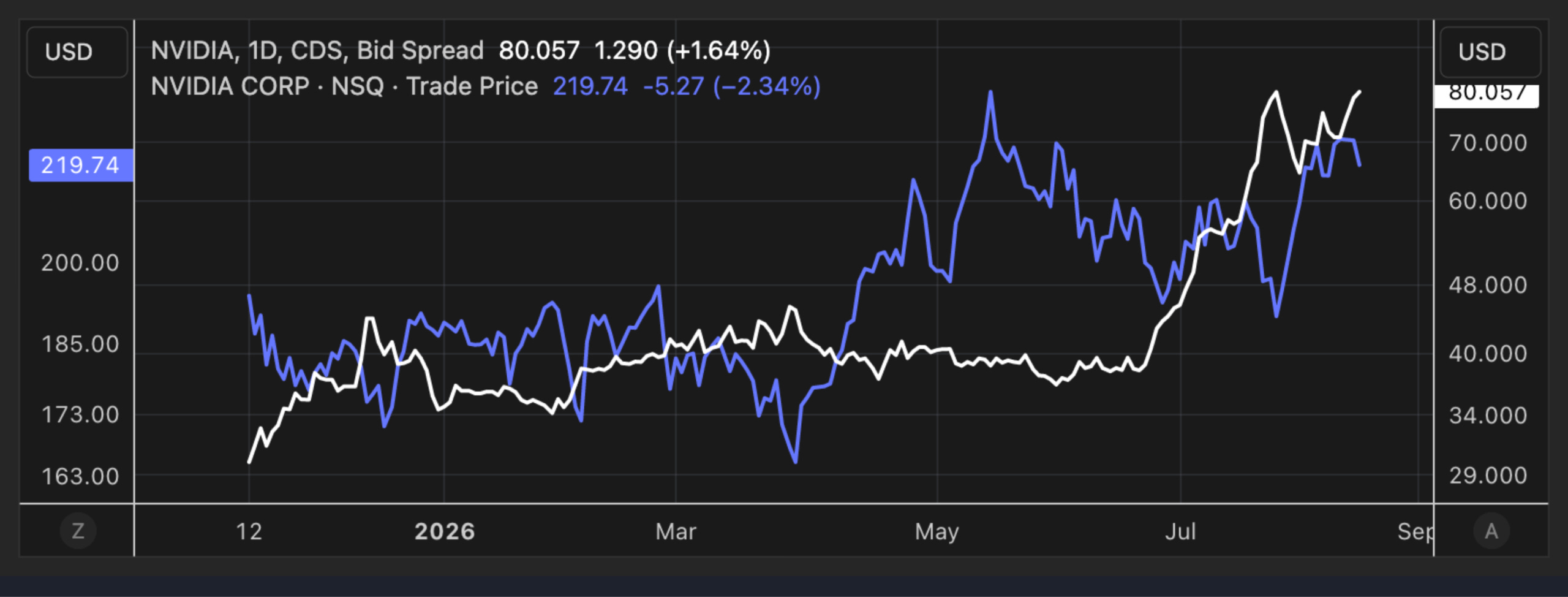
Stocks fell today, with the S&P 500 dropping by around 70 bps, and the NASDAQ by more than 1.5%. The sell-off was driven by the semiconductor sector, with companies again seeing credit spreads widen and, in some cases, taking out the highs seen back on July 29. The equity market has not seemed to reprice in line with the move seen in these CDS, so one wonders whether today’s market drop is the start of another semiconductor plunge like the one seen in July.
Nvidia widened out above the July levels, and yet the stock is significantly higher than where it was in less than a month.
(LSEG)
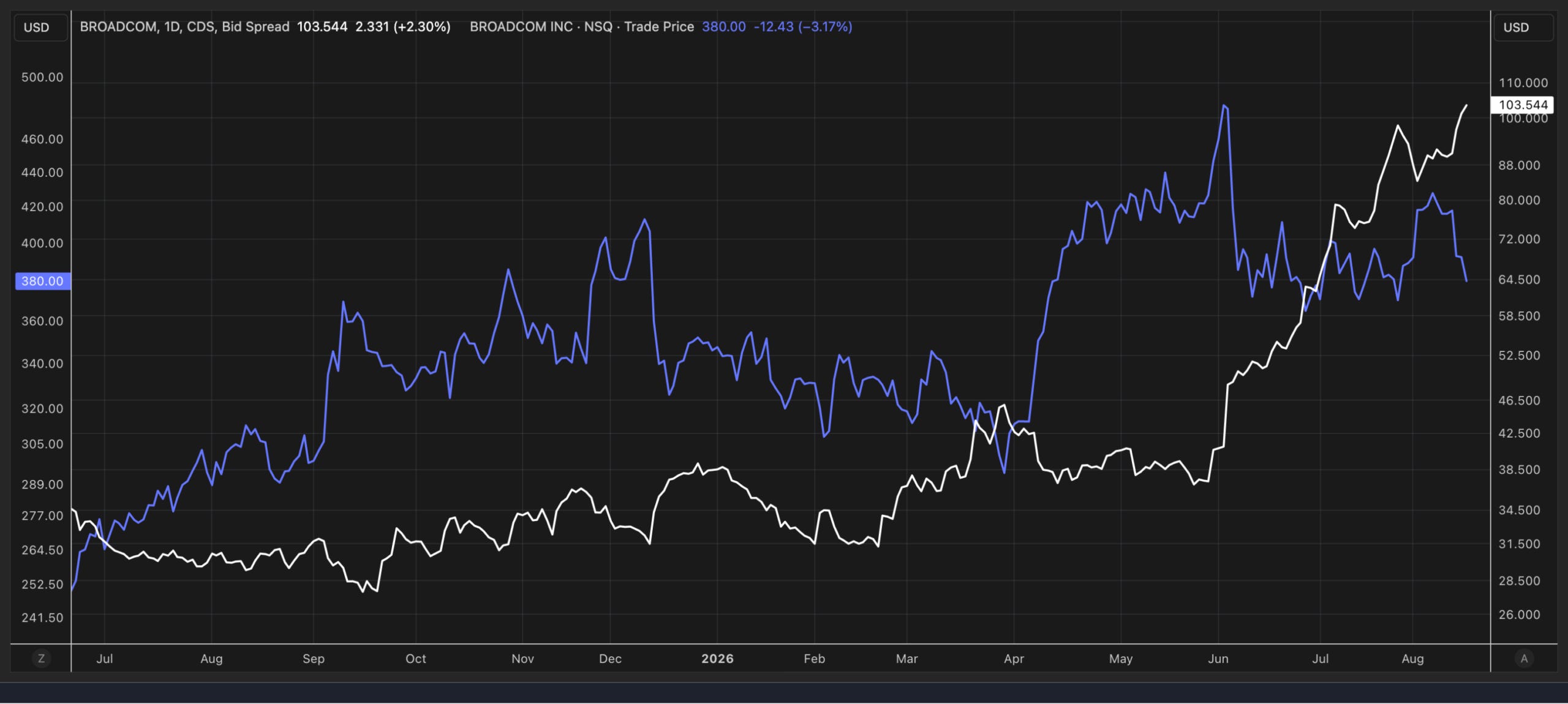
The movement in Broadcom seems more reflective of the credit market, much more so than in Nvidia.
(LSEG)
The interesting thing is that there is a lot of positive delta built up in the semiconductor ETF, with a large concentration at $600 and an equal amount at $550. As time value erodes and call premiums decay, calls at $600 and higher are likely to start losing significant value. If the SMH were to fall below $550, that could lead to even more decay, which could mean a lot of stock comes to market as hedging flows unwind.
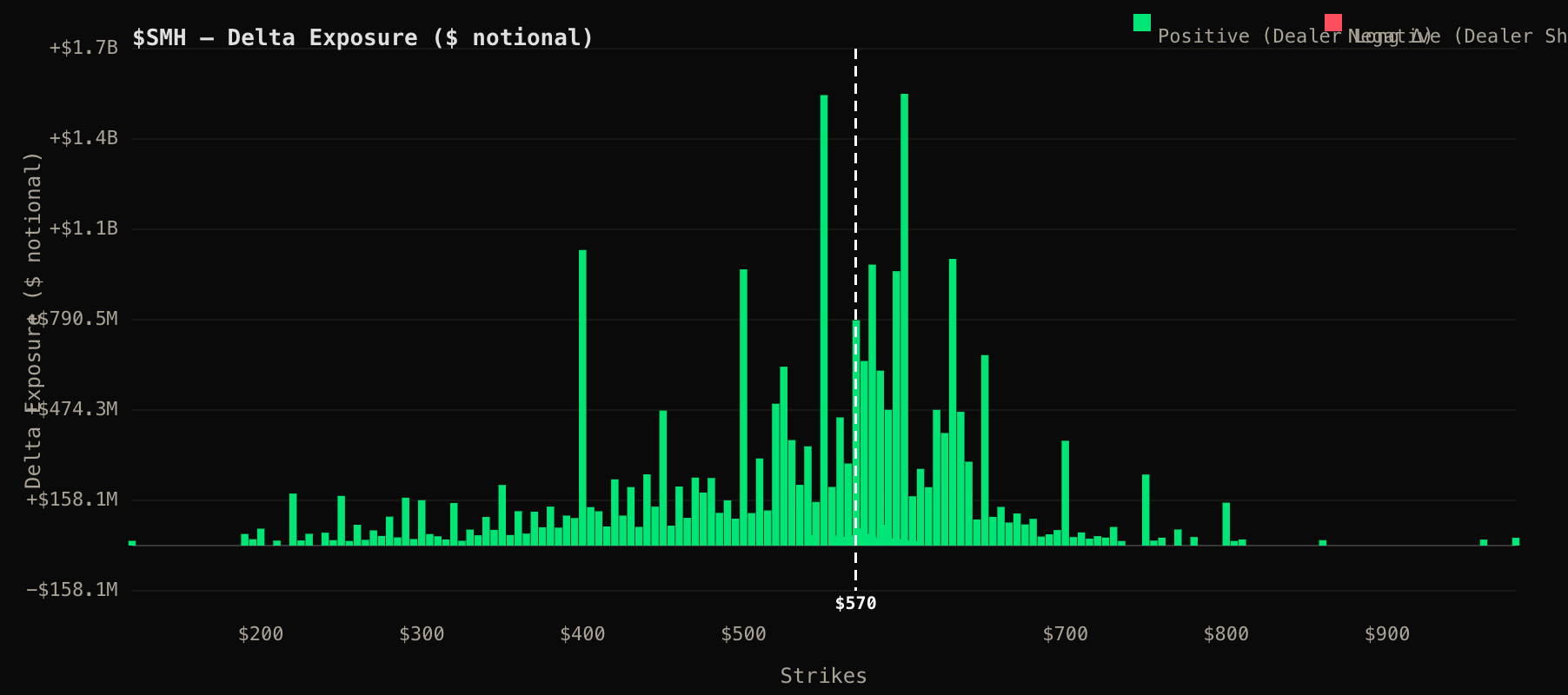
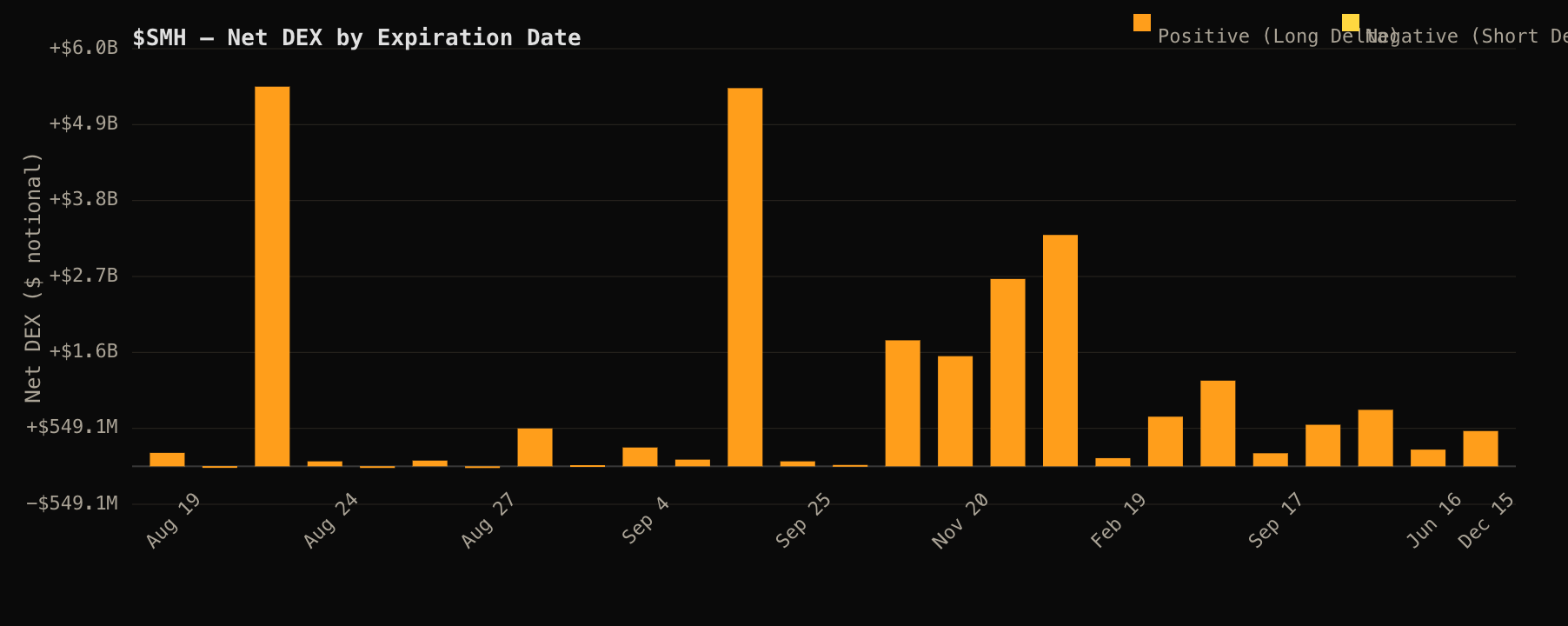
In fact, the largest delta position, as per my math, expires this Friday.
Implied correlations for the SMH were higher today, leading the broader index. Rising implied correlations have been one of the missing pieces in the market, as they give back some gains. Correlations have been suppressed for weeks, but with earnings largely over and dispersion coming down sharply, implied correlations should be poised to rise.
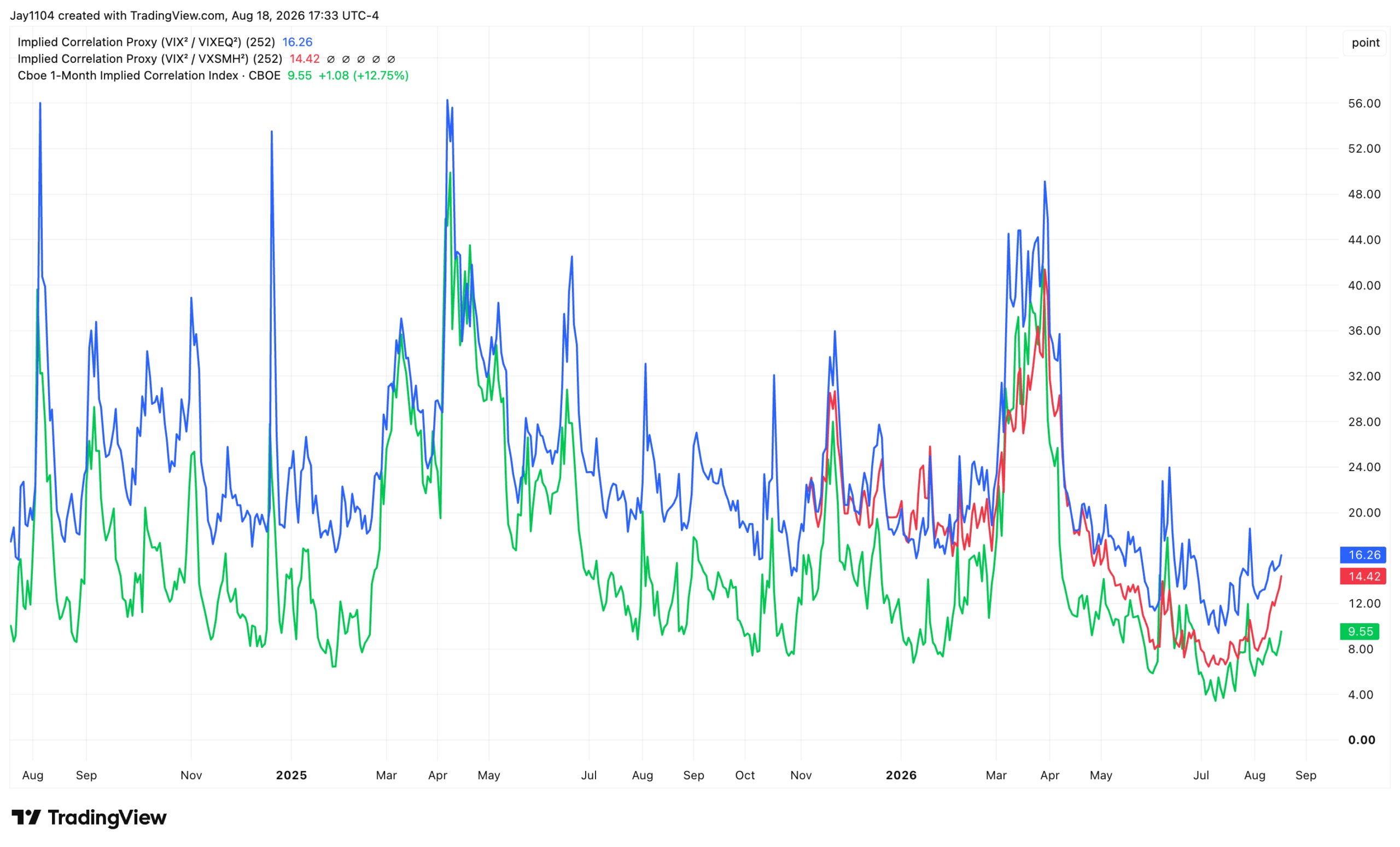
And this is all just mechanical factors that have nothing to do with rising interest rates or anything else going on in the world. This is just the unwind of earnings season starting to take over. When combined with the CDS widening, should that continue, along with climbing interest rates, the rest of the summer may prove to be a bit more challenging than it was billed to be a week or so ago.
-Mike
Glossary by ChatGPT
Call Premium — The price paid for a call option, consisting of intrinsic value, if any, plus remaining time value.
CDS — Credit default swaps, derivatives used to hedge or speculate on the credit risk of a company or other debt issuer.
Credit Spread — The yield premium investors demand to hold debt carrying credit risk relative to a comparable lower-risk benchmark.
Delta — An option sensitivity measure estimating how much an option’s price changes for a one-unit move in the underlying security.
Dispersion — The degree to which individual stock returns differ from one another, often reflected in the relationship between single-stock and index volatility.
Hedging Flows — Purchases or sales of an underlying security made to offset changes in the risk exposure of derivative positions.
Implied Correlation — The market-implied degree to which the components of an index are expected to move together, typically derived from option prices.
Time Value — The portion of an option’s premium attributable to the remaining time until expiration and the possibility of future favorable price movements.
Disclosure
This report contains independent commentary to be used for informational and educational purposes only. Michael Kramer is a member and investment adviser representative with Mott Capital Management. Mr. Kramer is not affiliated with this company and does not serve on the board of any related company that issued this stock. All opinions and analyses presented by Michael Kramer in this analysis or market report are solely Michael Kramer’s views. Readers should not treat any opinion, viewpoint, or prediction expressed by Michael Kramer as a specific solicitation or recommendation to buy or sell a particular security or follow a particular strategy. Michael Kramer’s analyses are based upon information and independent research that he considers reliable, but neither Michael Kramer nor Mott Capital Management guarantees its completeness or accuracy, and it should not be relied upon as such. Michael Kramer is not under any obligation to update or correct any information presented in his analyses. Mr. Kramer’s statements, guidance, and opinions are subject to change without notice. Past performance is not indicative of future results. Neither Michael Kramer nor Mott Capital Management guarantees any specific outcome or profit. You should be aware of the real risk of loss in following any strategy or investment commentary presented in this analysis. Strategies or investments discussed may fluctuate in price or value. Investments or strategies mentioned in this analysis may not be suitable for you. This material does not consider your particular investment objectives, financial situation, or needs and is not intended as a recommendation appropriate for you. You must make an independent decision regarding investments or strategies in this analysis. Upon request, the advisor will provide a list of all recommendations made during the past twelve months. Before acting on information in this analysis, you should consider whether it is suitable for your circumstances and strongly consider seeking advice from your own financial or investment adviser to determine the suitability of any investment.