
S&P 500 Rally Runs Against Further Liquidity Tightening

A housekeeping note: There will be no free daily commentaries this week. They will resume on Saturday, August 22. Updates to the subscription service will also be limited due to market conditions.
Stocks rallied on Friday, but I think it’s fairly clear that the gamma squeeze has run its course, and the market has largely returned to normal trading flows. Net options volume shifted back toward puts leading calls after the sharp surge in activity earlier in the week that pushed the market from a negative gamma regime into a positive one.
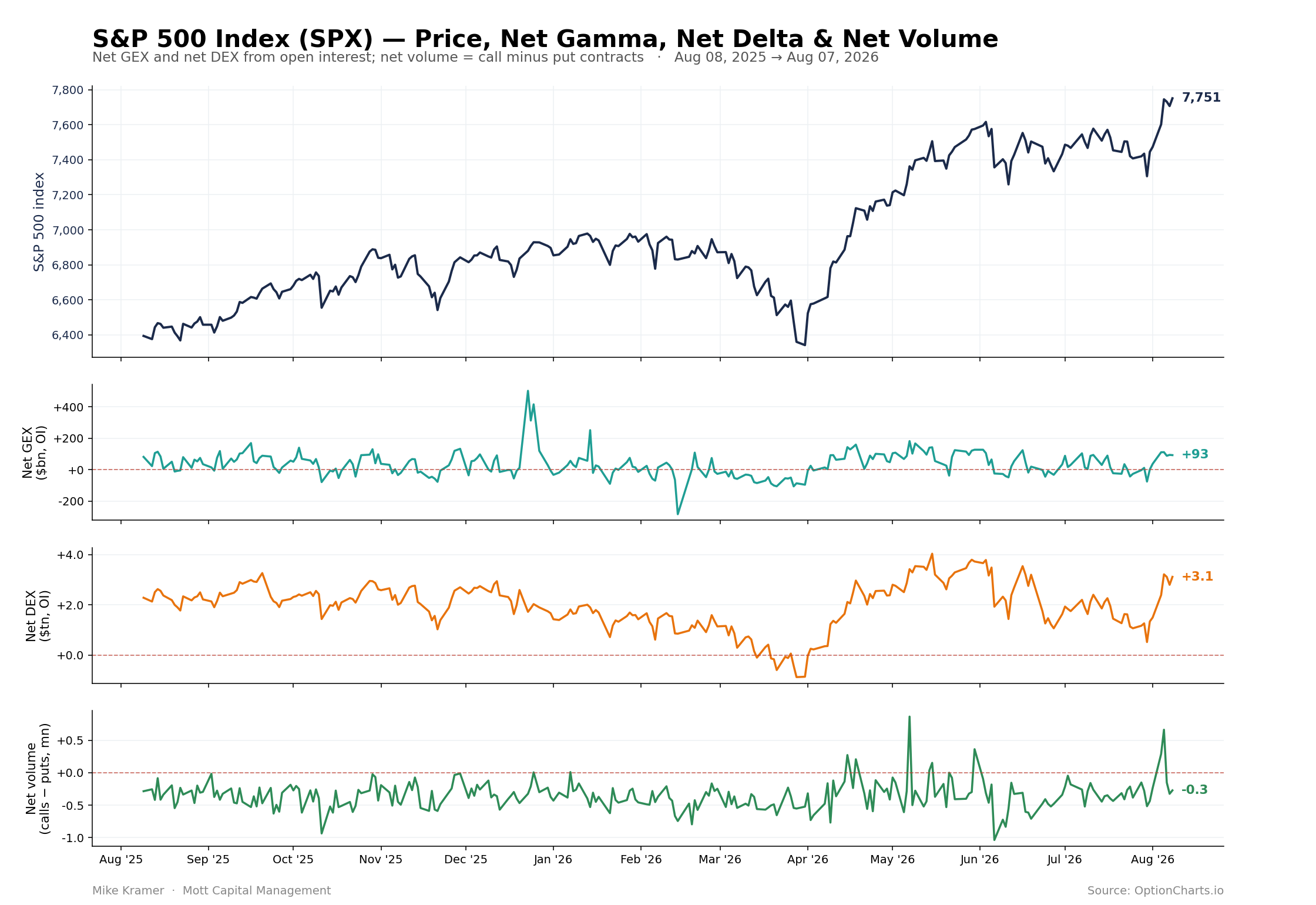
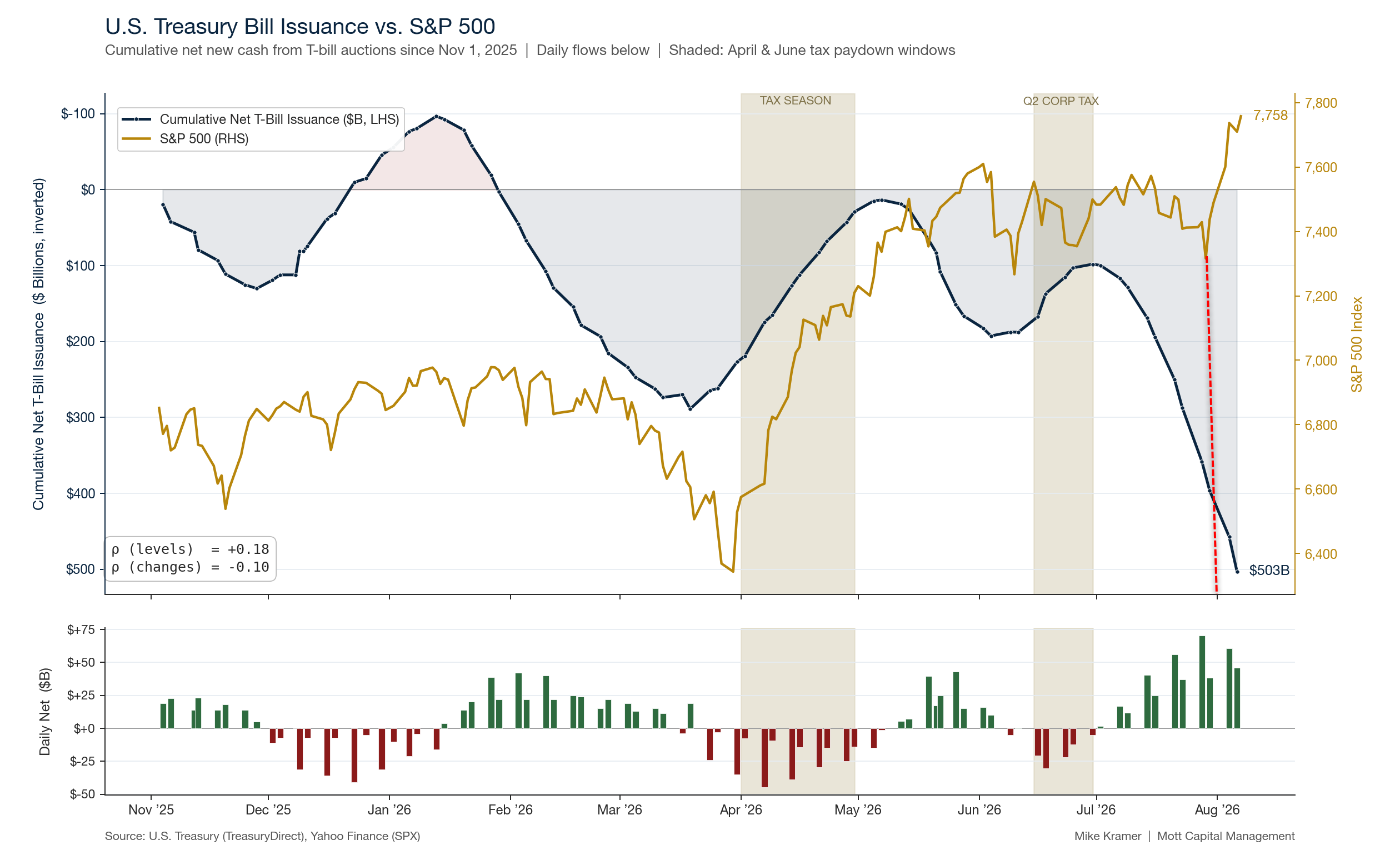
T-bill issuance will remain heavy over the next few weeks, so liquidity should continue to be an important driver of the market. Until the recent three-day rally, that relationship had been working quite well. This episode, however, shows that forces outside of liquidity can still dominate market direction. Overall, as the chart illustrates, the market has tended to move in a slow, grinding fashion, and I would not be surprised to see that downward-tilting grind resume.
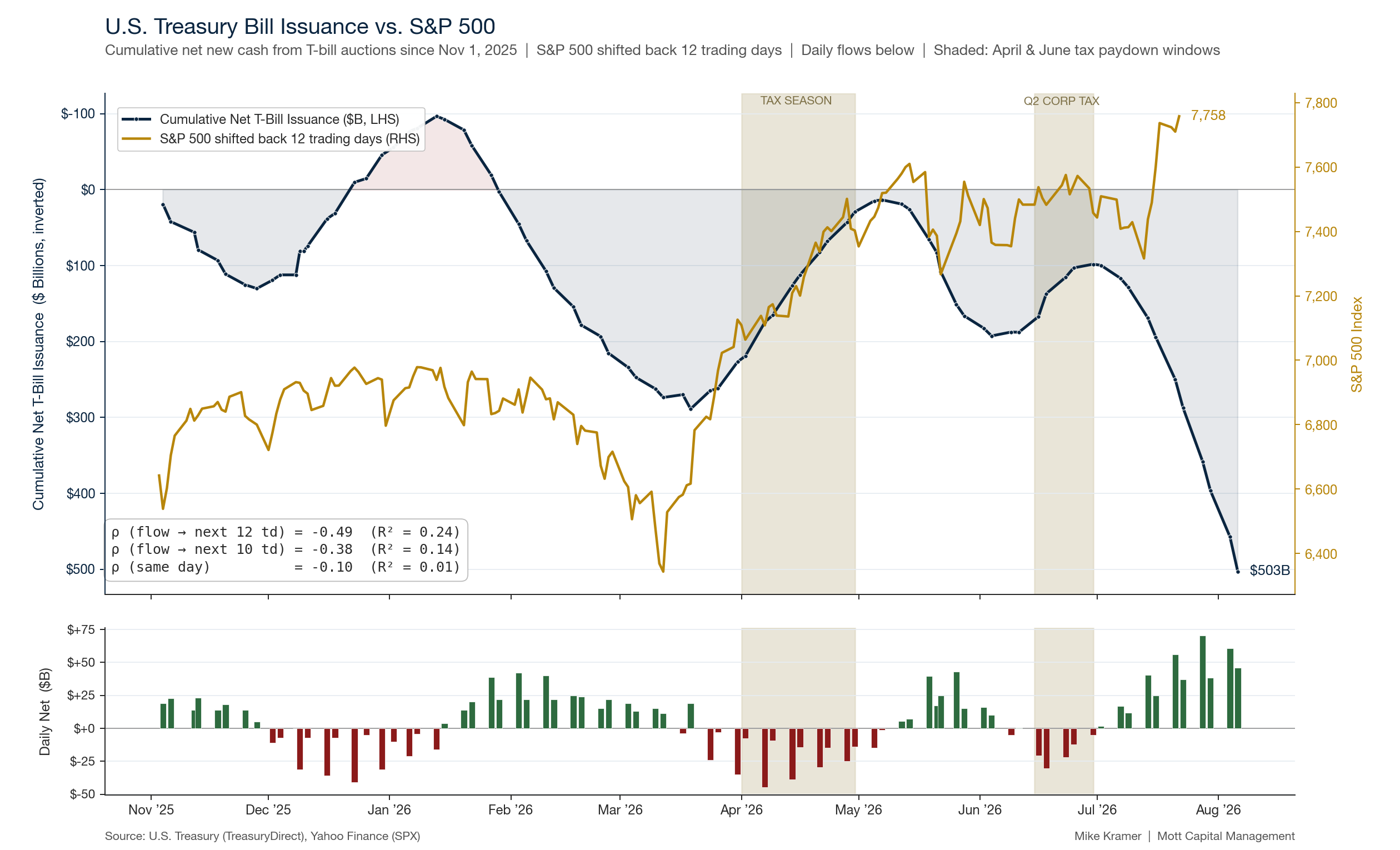
The next chart shows what happens when the S&P 500 is shifted back by 12 days. The correlation strengthens from -0.10 to -0.49, with the R² increasing to 0.24. If the effects of the liquidity drain are strongest roughly two weeks after the actual drain date, then we are only now entering the period when the market should feel the greatest impact.
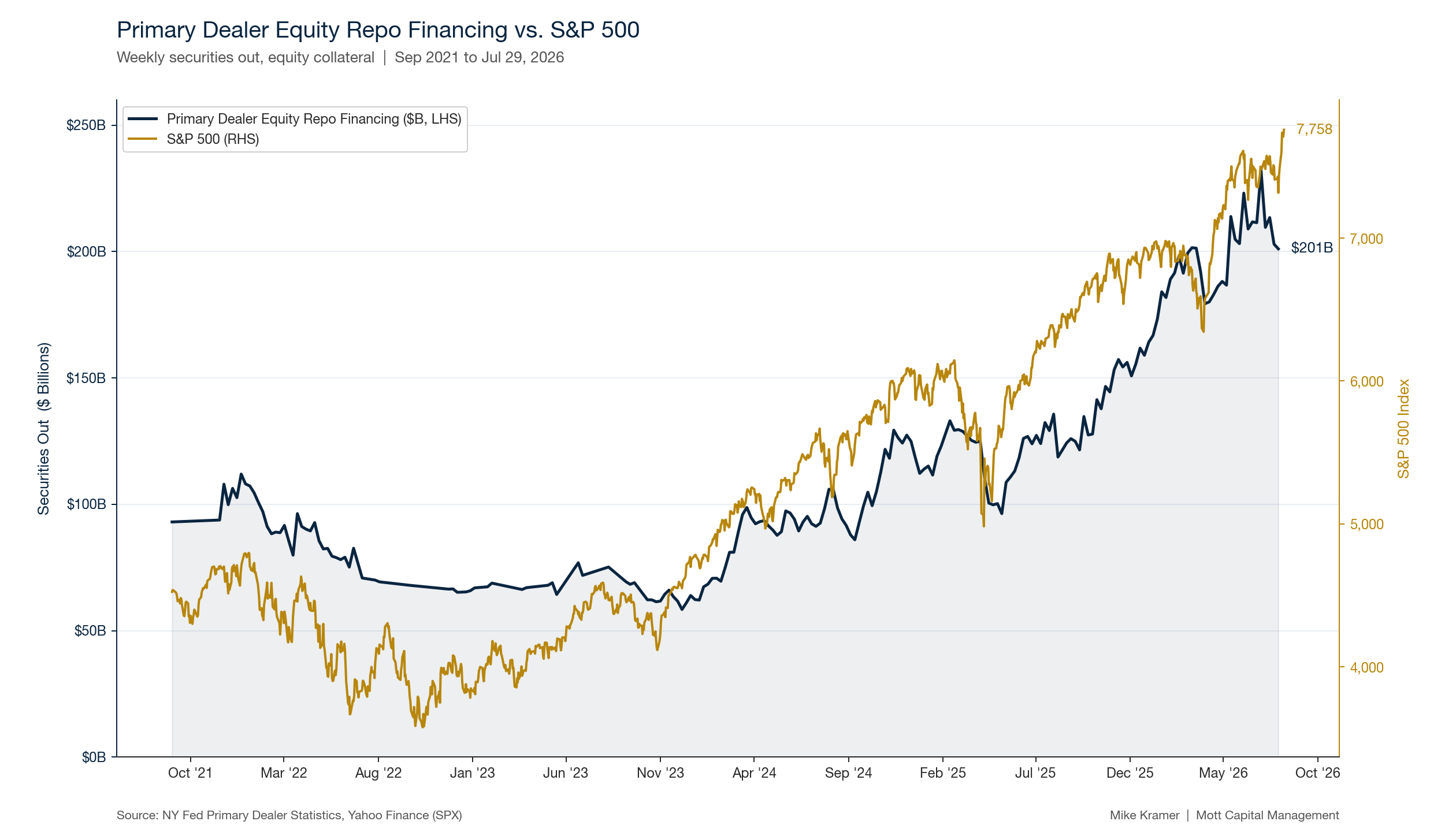
Additionally, equity repo financing activity, as tracked by the New York Fed, has declined in recent weeks. While the data currently only extends through July 29, the reports for the weeks ending August 6 and August 13 will be particularly important. We’ll have to wait for those releases, but if the market continues to rally without a corresponding pickup in equity repo financing, it would suggest that forces other than liquidity are driving the advance.
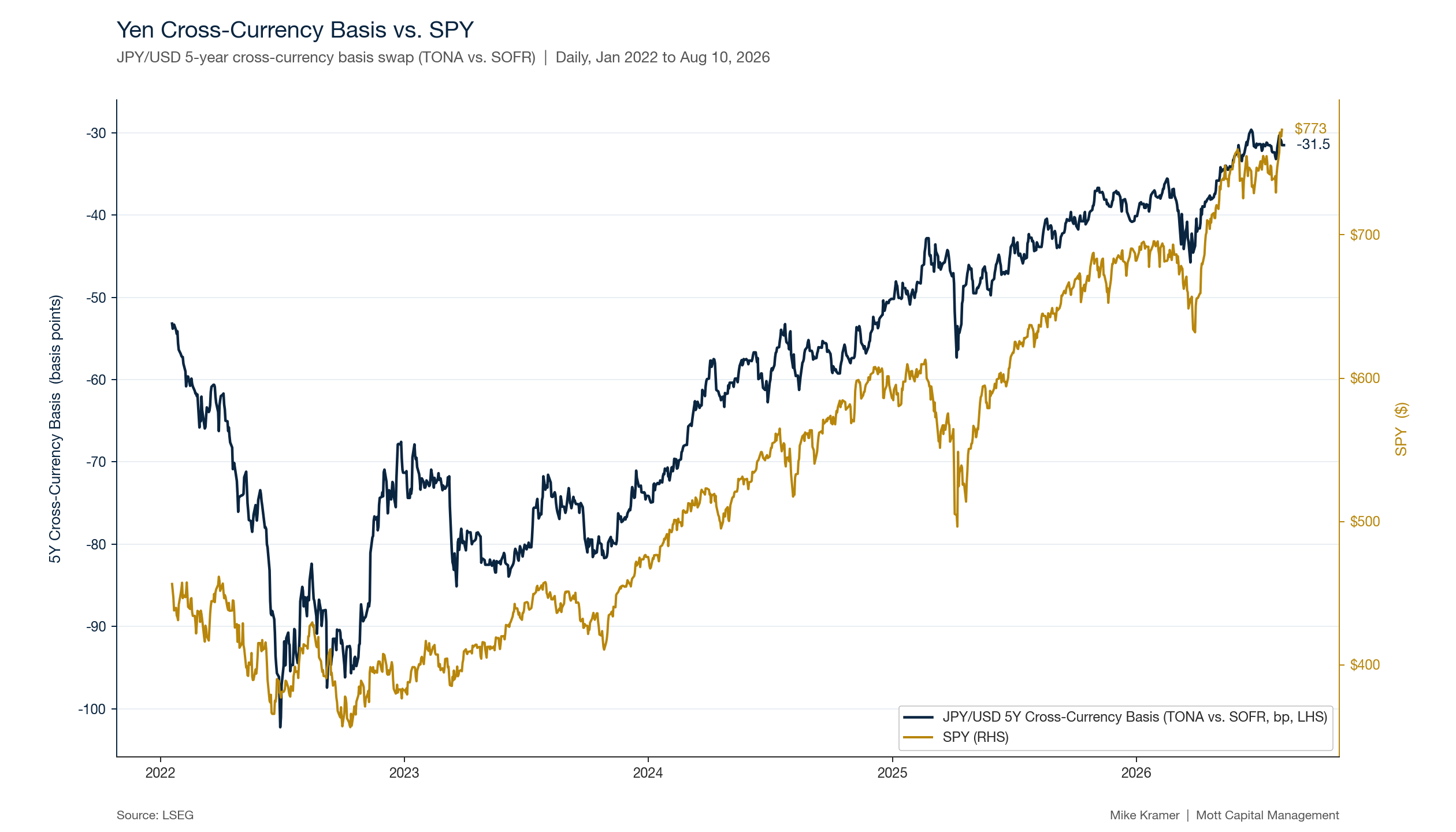
Additionally, we have begun to see some activity in the five-year USD/JPY cross-currency basis swap. While the move has been modest, it could be an early sign that hedging demand is increasing. With both U.S. and Japanese policymakers seemingly unwilling to tolerate further yen weakness, increased currency hedging could divert dollars away from the equity market and reduce a source of liquidity for risk assets.
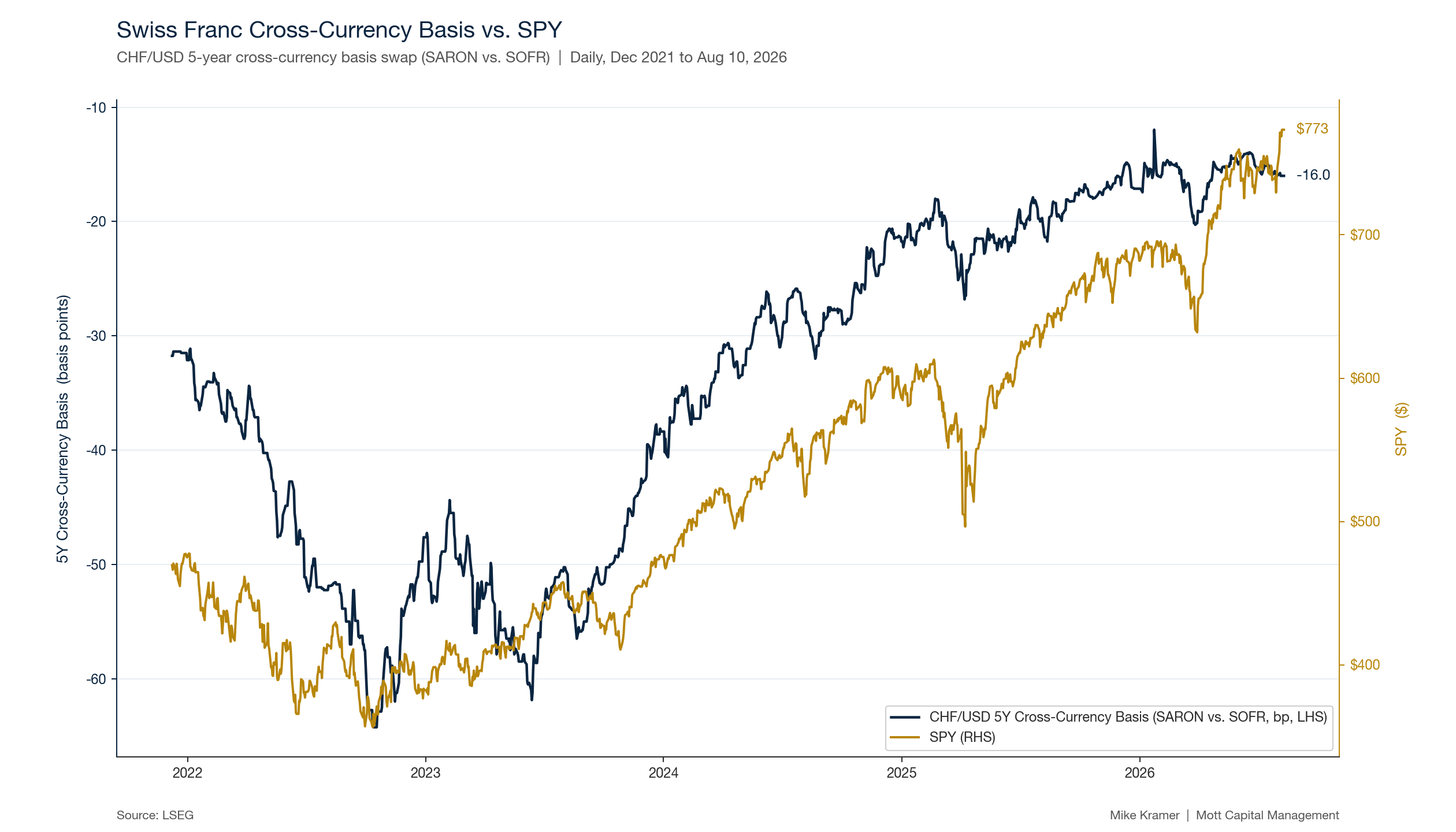
The same is true for the five-year USD/CHF cross-currency basis swap.
So, if liquidity continues to tighten as it has been, and the gamma squeeze has indeed run its course, I would expect the market to return to the environment that existed before the squeeze began.
Anyway, I guess we’ll see where things stand when I return next Saturday.
-Mike
Glossary by ChatGPT
Cross-currency basis swap — A derivative that exchanges funding in two currencies, with the basis reflecting relative demand and funding conditions between them.
Equity repo financing — Short-term secured financing backed by equity securities, often used as an indicator of leverage and funding availability in equity markets.
Gamma squeeze — A market move amplified when options dealers must buy or sell the underlying asset to hedge rapidly changing options exposure.
Negative gamma regime — A positioning environment in which dealer hedging can amplify market moves by selling as prices fall and buying as prices rise.
Net options volume — The relative balance of options trading activity, such as put versus call volume, used to assess positioning and directional demand.
Positive gamma regime — A positioning environment in which dealer hedging tends to dampen market moves by buying declines and selling rallies.
R² — A statistical measure showing how much of the variation in one variable is explained by its relationship with another variable.
T-bill issuance — The sale of short-term U.S. Treasury securities, which can affect financial-system liquidity by absorbing available cash.
USD/CHF cross-currency basis swap — A cross-currency funding instrument whose basis reflects relative demand to exchange U.S. dollar and Swiss franc funding.
USD/JPY cross-currency basis swap — A cross-currency funding instrument whose basis reflects relative demand to exchange U.S. dollar and Japanese yen funding.
Disclosure
This report contains independent commentary to be used for informational and educational purposes only. Michael Kramer is a member and investment adviser representative with Mott Capital Management. Mr. Kramer is not affiliated with this company and does not serve on the board of any related company that issued this stock. All opinions and analyses presented by Michael Kramer in this analysis or market report are solely Michael Kramer’s views. Readers should not treat any opinion, viewpoint, or prediction expressed by Michael Kramer as a specific solicitation or recommendation to buy or sell a particular security or follow a particular strategy. Michael Kramer’s analyses are based upon information and independent research that he considers reliable, but neither Michael Kramer nor Mott Capital Management guarantees its completeness or accuracy, and it should not be relied upon as such. Michael Kramer is not under any obligation to update or correct any information presented in his analyses. Mr. Kramer’s statements, guidance, and opinions are subject to change without notice. Past performance is not indicative of future results. Neither Michael Kramer nor Mott Capital Management guarantees any specific outcome or profit. You should be aware of the real risk of loss in following any strategy or investment commentary presented in this analysis. Strategies or investments discussed may fluctuate in price or value. Investments or strategies mentioned in this analysis may not be suitable for you. This material does not consider your particular investment objectives, financial situation, or needs and is not intended as a recommendation appropriate for you. You must make an independent decision regarding investments or strategies in this analysis. Upon request, the advisor will provide a list of all recommendations made during the past twelve months. Before acting on information in this analysis, you should consider whether it is suitable for your circumstances and strongly consider seeking advice from your own financial or investment adviser to determine the suitability of any investment.