
S&P 500 Consolidation Signals Rising Risk as Yields and Dollar Strengthen

The S&P 500 fell about 40 basis points on the day, with technology stocks leading the decline. If not for the strength in semiconductors, the sell-off could have been much worse.
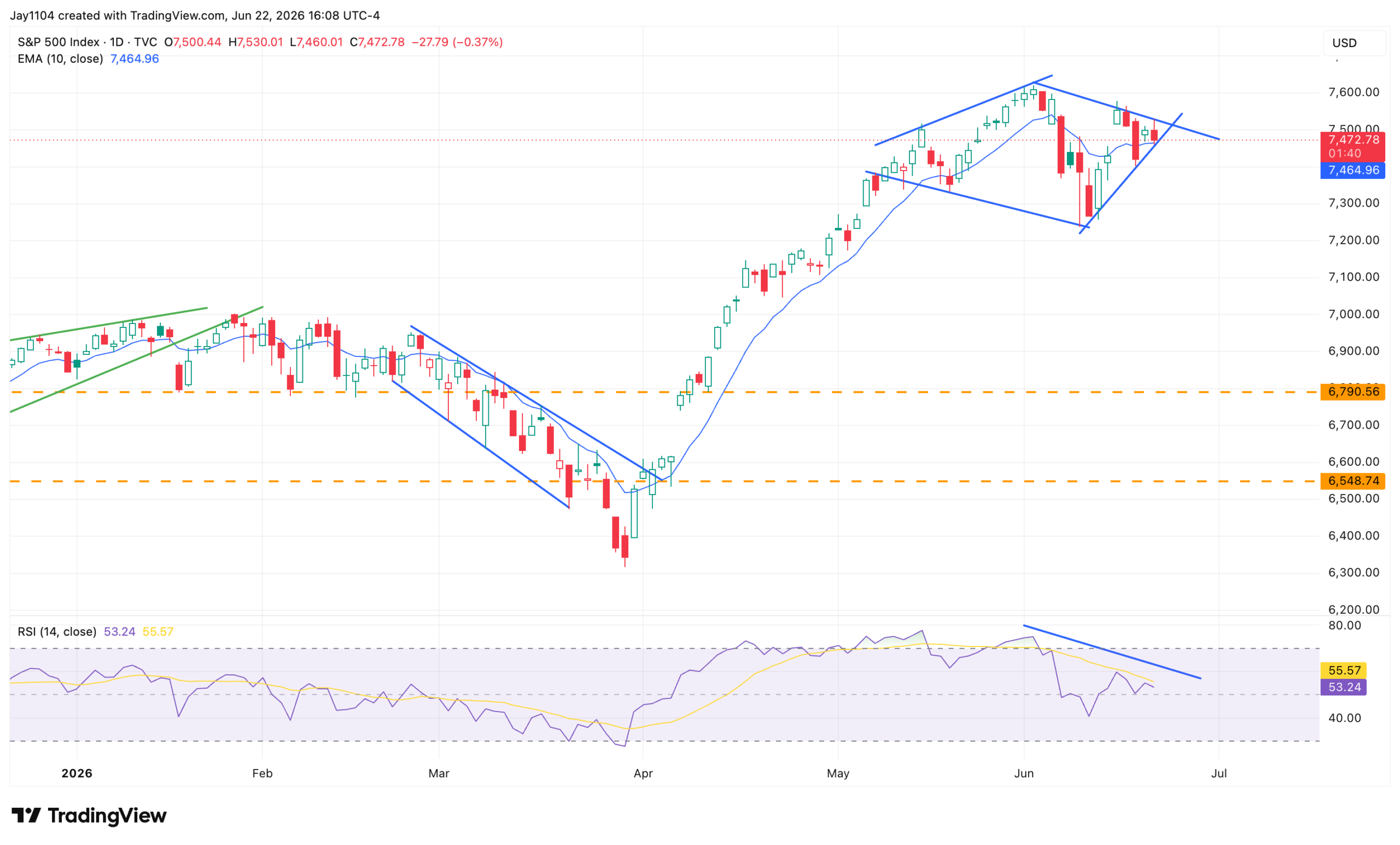
What is becoming increasingly clear from a technical perspective in the S&P 500 is that the index is consolidating and may be forming a diamond pattern. There appears to have been a widening formation leading into the June 2 peak, followed by the current consolidation phase, which is consistent with a diamond top pattern.
Meanwhile, the falling RSI suggests that momentum has faded significantly over the past several weeks and has yet to recover. That would be viewed as a negative technical signal for the index.
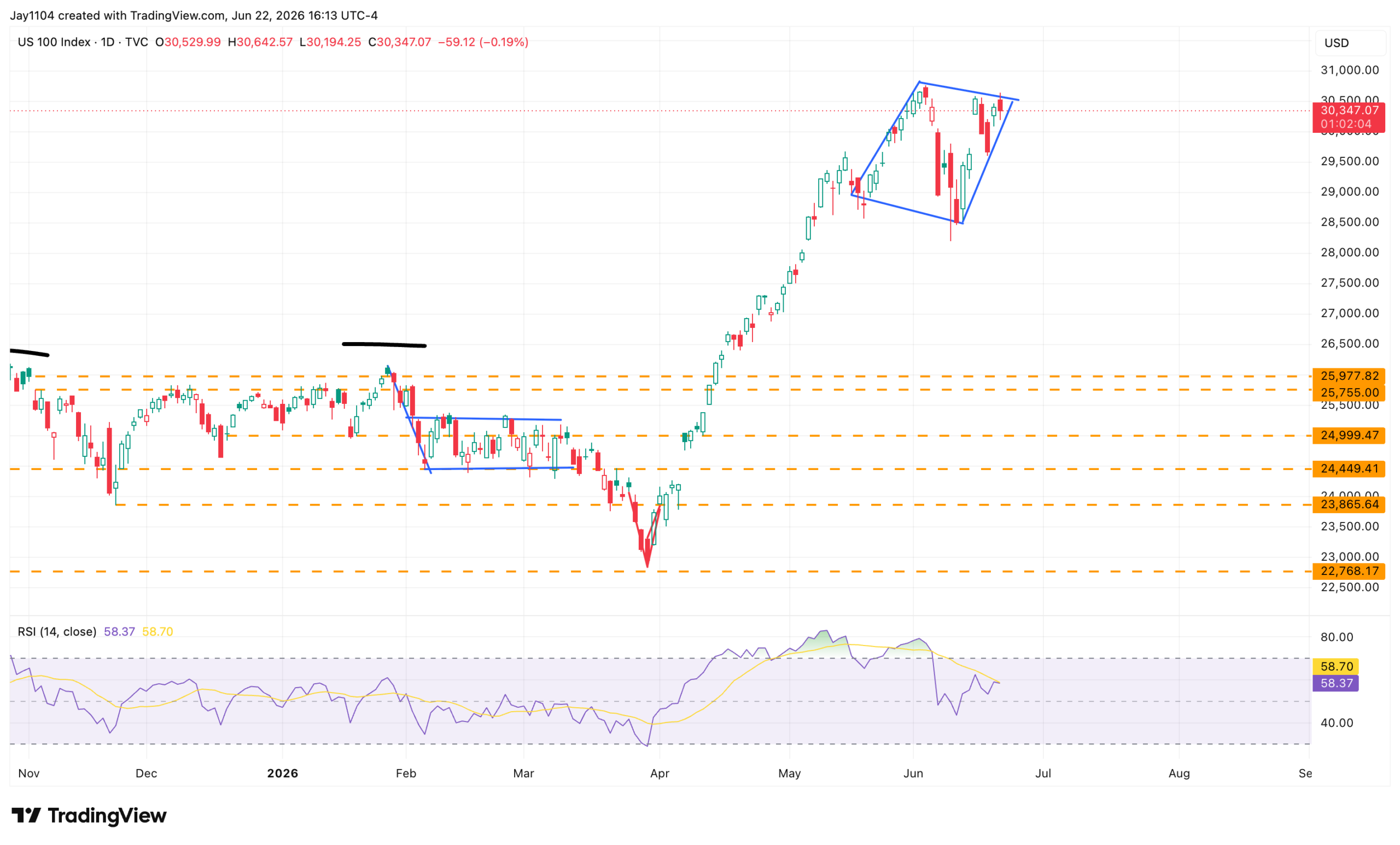
I’m not entirely sure what to call the pattern in the Nasdaq 100 at this point—perhaps a parallelogram or some form of narrowing consolidation. Regardless of the label, both the Nasdaq 100 and the S&P 500 have spent the past several days consolidating. The trading ranges continue to tighten, and the wedge appears to be nearing completion, suggesting that a breakout in either direction could be approaching.
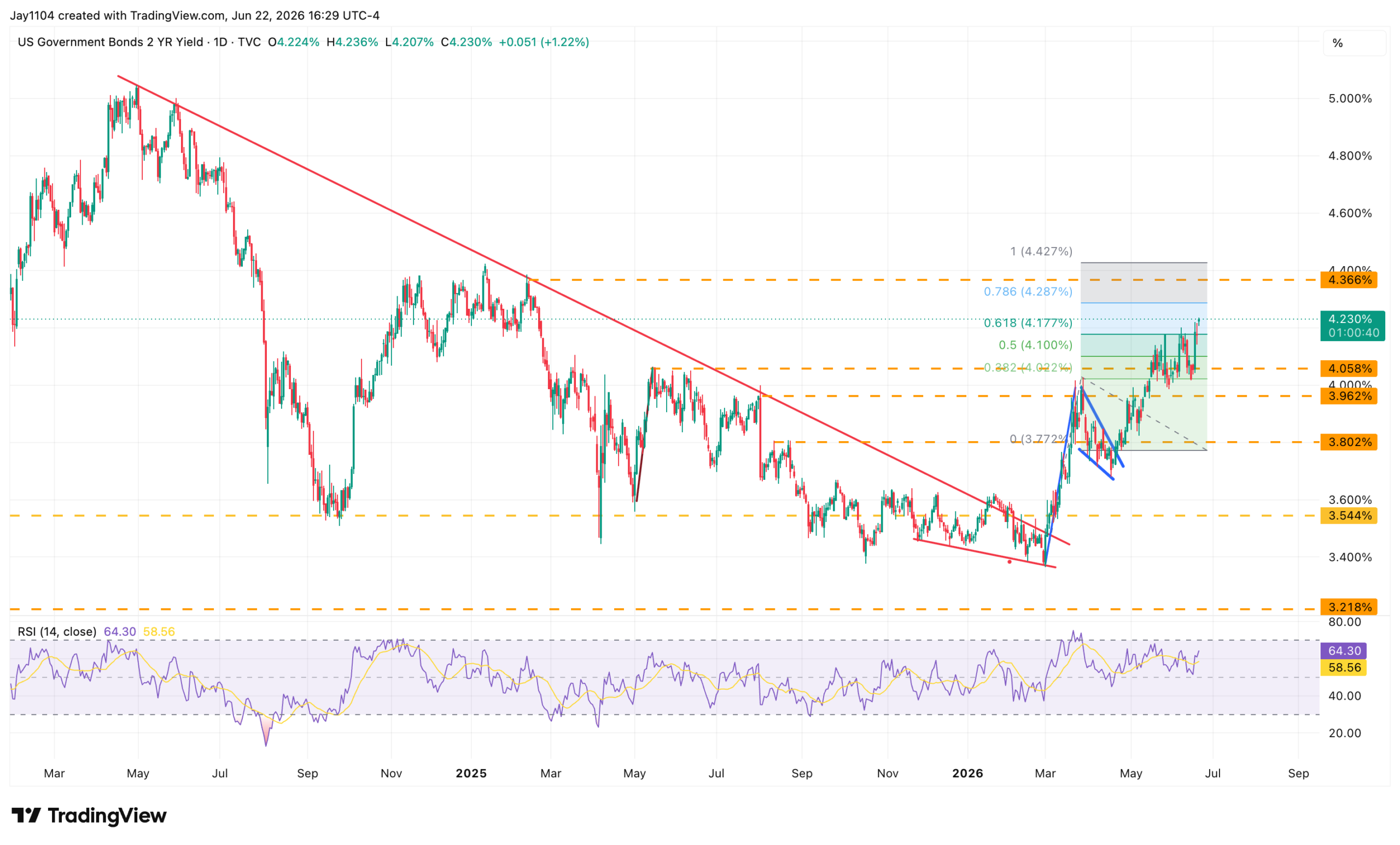
Two-year Treasury yields rose on the day despite falling oil prices, climbing to roughly 4.25%. If the 2-year yield has indeed broken out of the bull pennant highlighted on the chart, the measured move projection would suggest a rise toward 4.4%.
Such a move would likely reinforce the recent tightening in financial conditions and could present an additional headwind for equities.
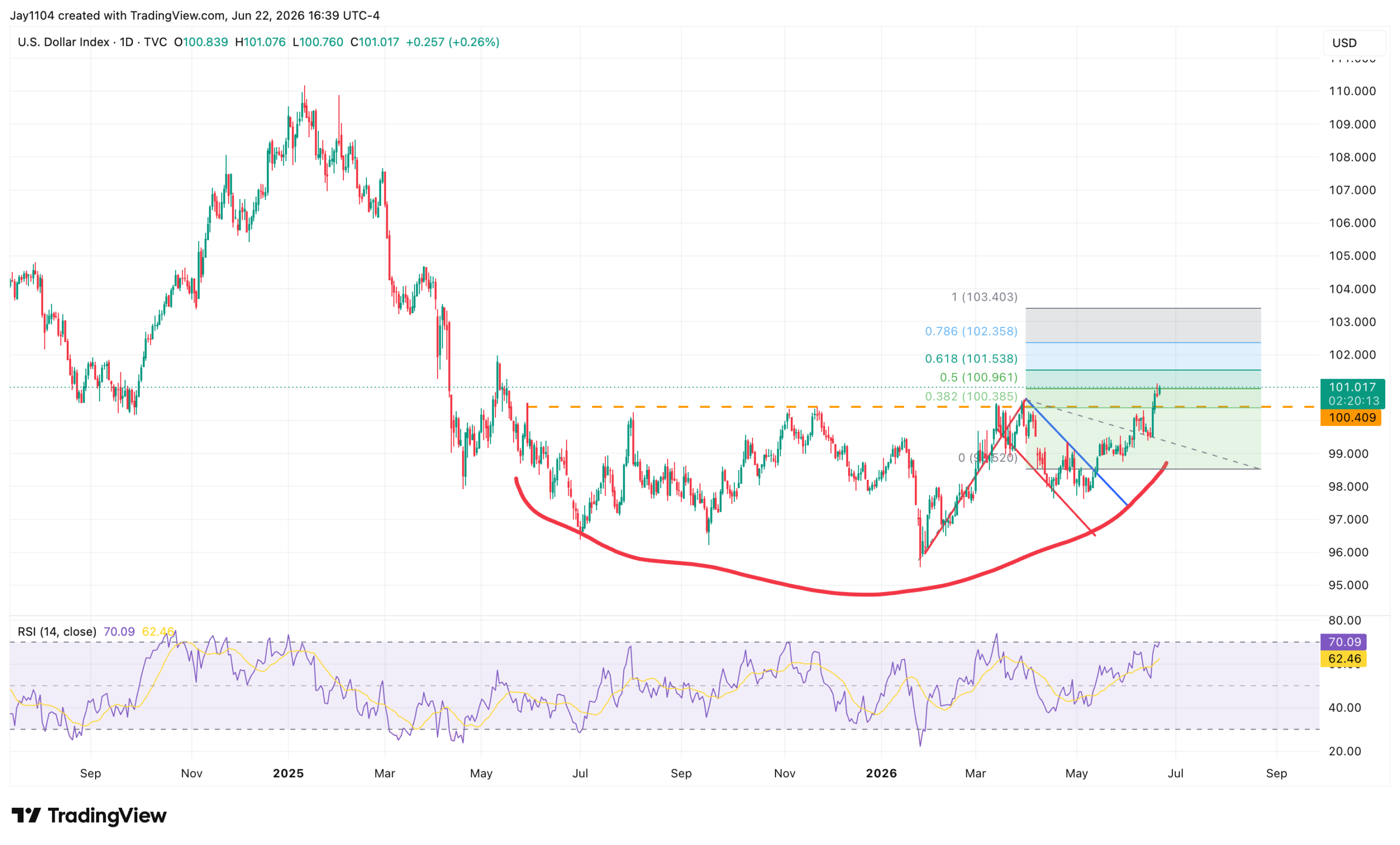
Meanwhile, the Dollar Index continued to strengthen, having broken above resistance at 100.50 last week and now trading north of 101. If the pattern is similar to the bull pennant seen in the 2-year yield, the measured-move projection would suggest the Dollar Index could extend its rally toward 103.40.
A move of that magnitude would likely create additional pressure on risk assets, weigh on commodities, and further tighten financial conditions.
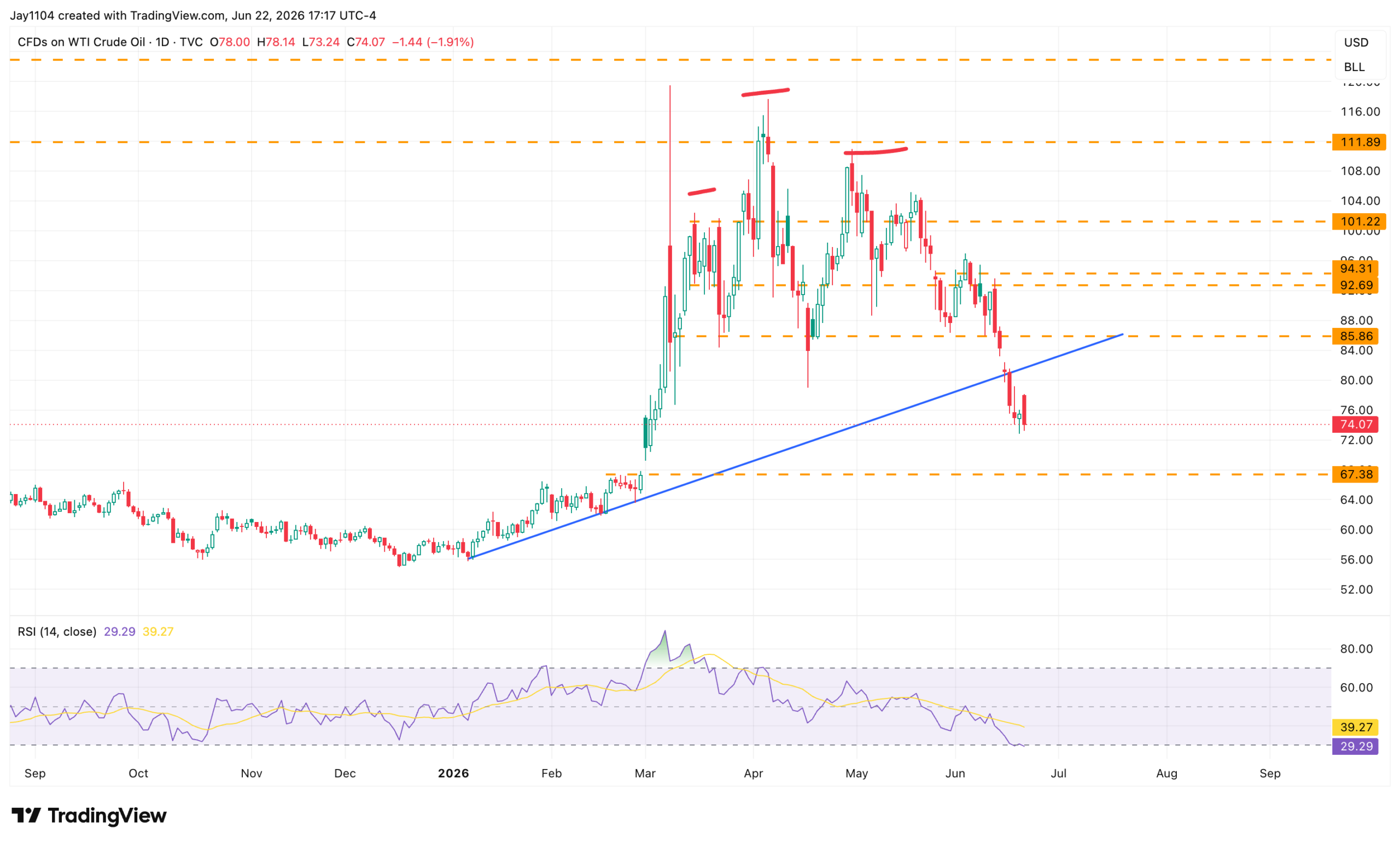
Oil prices fell again and continue to weaken as the market looks beyond tensions in the Middle East. A move down to around $67 would fill the gap created in early March and complete the unwind of the bearish head-and-shoulders pattern that had previously formed.
For now, the technical setup suggests that the recent geopolitical premium in oil prices continues to fade as supply concerns ease and traders refocus on broader macroeconomic factors.
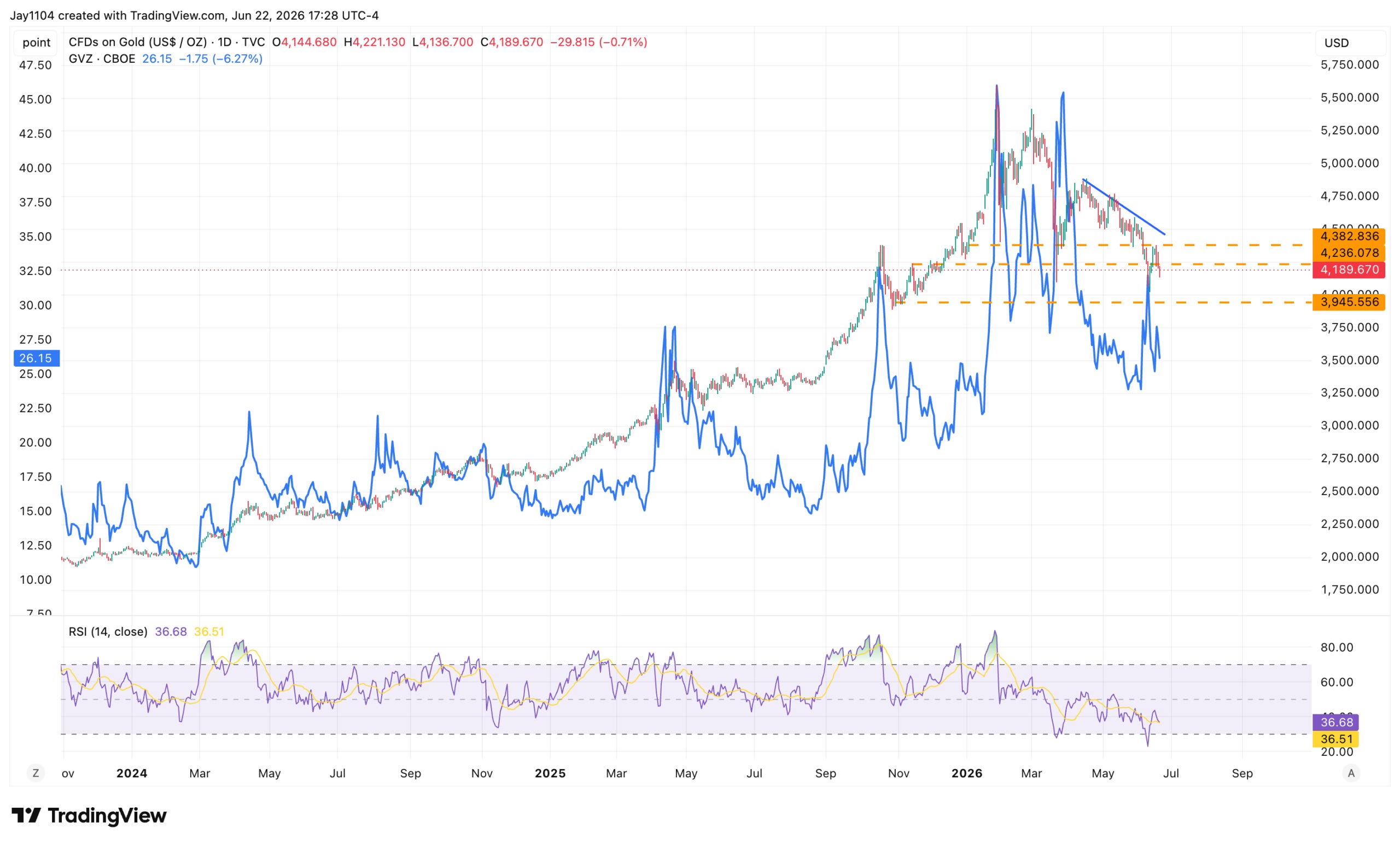
Finally, gold prices continue to slip, and that weakness may persist, as implied volatility in gold continues to decline. The feverish sentiment that once surrounded gold continues to fade, and with implied volatility still around 26%, there is room for it to fall significantly further. That suggests the decline in gold prices may be far from over. A stronger dollar certainly won’t help matters.
-Mike
Glossary by ChatGPT
Basis Point (bp) — One one-hundredth of a percentage point, equal to 0.01%.
Bearish Head-and-Shoulders Pattern — A technical chart formation that often signals a potential trend reversal from bullish to bearish.
Breakout — A price move above resistance or below support that may signal the start of a new trend.
Bull Pennant — A continuation chart pattern characterized by a brief consolidation following a strong upward move.
Diamond Top Pattern — A technical reversal pattern featuring expanding and then contracting price swings that can signal a market peak.
Financial Conditions — A measure of how easy or difficult it is for businesses and consumers to access capital, influenced by rates, credit spreads, and asset prices.
Geopolitical Premium — The portion of an asset’s price attributable to political or geopolitical risks rather than underlying fundamentals.
Implied Volatility — The market’s expectation of future price fluctuations derived from option prices.
Measured Move — A technical analysis technique used to estimate a price target based on the size of a prior price movement.
Momentum — The rate at which an asset’s price is changing over time.
Relative Strength Index (RSI) — A momentum indicator that measures the speed and magnitude of price movements on a scale from 0 to 100.
Resistance — A price level where selling pressure has historically been strong enough to limit further gains.
Risk Assets — Investments such as equities, commodities, and high-yield bonds that tend to perform better when investors are willing to take on risk.
Wedge Pattern — A chart formation marked by converging trendlines that often precedes a breakout in either direction.
Disclosure
This report contains independent commentary to be used for informational and educational purposes only. Michael Kramer is a member and investment adviser representative with Mott Capital Management. Mr. Kramer is not affiliated with this company and does not serve on the board of any related company that issued this stock. All opinions and analyses presented by Michael Kramer in this analysis or market report are solely Michael Kramer’s views. Readers should not treat any opinion, viewpoint, or prediction expressed by Michael Kramer as a specific solicitation or recommendation to buy or sell a particular security or follow a particular strategy. Michael Kramer’s analyses are based upon information and independent research that he considers reliable, but neither Michael Kramer nor Mott Capital Management guarantees its completeness or accuracy, and it should not be relied upon as such. Michael Kramer is not under any obligation to update or correct any information presented in his analyses. Mr. Kramer’s statements, guidance, and opinions are subject to change without notice. Past performance is not indicative of future results. Neither Michael Kramer nor Mott Capital Management guarantees any specific outcome or profit. You should be aware of the real risk of loss in following any strategy or investment commentary presented in this analysis. Strategies or investments discussed may fluctuate in price or value. Investments or strategies mentioned in this analysis may not be suitable for you. This material does not consider your particular investment objectives, financial situation, or needs and is not intended as a recommendation appropriate for you. You must make an independent decision regarding investments or strategies in this analysis. Upon request, the advisor will provide a list of all recommendations made during the past twelve months. Before acting on information in this analysis, you should consider whether it is suitable for your circumstances and strongly consider seeking advice from your own financial or investment adviser to determine the suitability of any investment.