
Reading a Geopolitical Setup — Oil Through the Iran Cycle

Reading a Geopolitical Setup — Oil Through the Iran Cycle
Geopolitics is the unscheduled catalyst. Where a central bank decision arrives on a date the market has been waiting for — with positioning, expectations, and pricing all built around the calendar — a geopolitical shock arrives without warning, and the chart finds out at the same time everyone else does.
That changes how the framework operates. Not the steps. Not the discipline. The inputs and the asymmetry. The macro question shifts from “what does the central bank believe about inflation” to “what is the headline risk this week, and what does the option market say about it.” And invalidation shifts from a hawkish surprise to a single ceasefire headline that gaps the chart in three minutes.
Oil through the Iran cycle is the cleanest current demonstration.
What makes an oil setup different
The catalyst arrives without permission. A central bank tells you when it will speak. The news cycle does not. A drone strike, a tanker incident, a ceasefire rumor — any of these can move oil 5% in an afternoon. That removes the luxury of pre-positioning into a known event. The job becomes about staying ready for any of several plausible catalysts, not preparing for one.
Implied volatility is the macro signal. In FX, the rate differential tells you which way the structural wind is blowing. In oil during a geopolitical cycle, the OVX — the CBOE Crude Oil Volatility Index — tells you the same thing in a different language. Rising OVX is the market paying up for protection, expecting the regime to continue or escalate. Falling OVX is the market unwinding of that protection, which creates an asymmetry: positioning is thinner, so the next escalation headline lands harder.
The levels are wider but no less precise. In FX, a 2% move is a meaningful day. In oil during a geopolitical cycle, 5% can happen on a single headline, and 10% can happen on a weekend. The technical levels are still real — still tested, still respected, still the points around which price organizes. The amplitude shifts. The structure does not.
Reading the Brent setup, mid-April
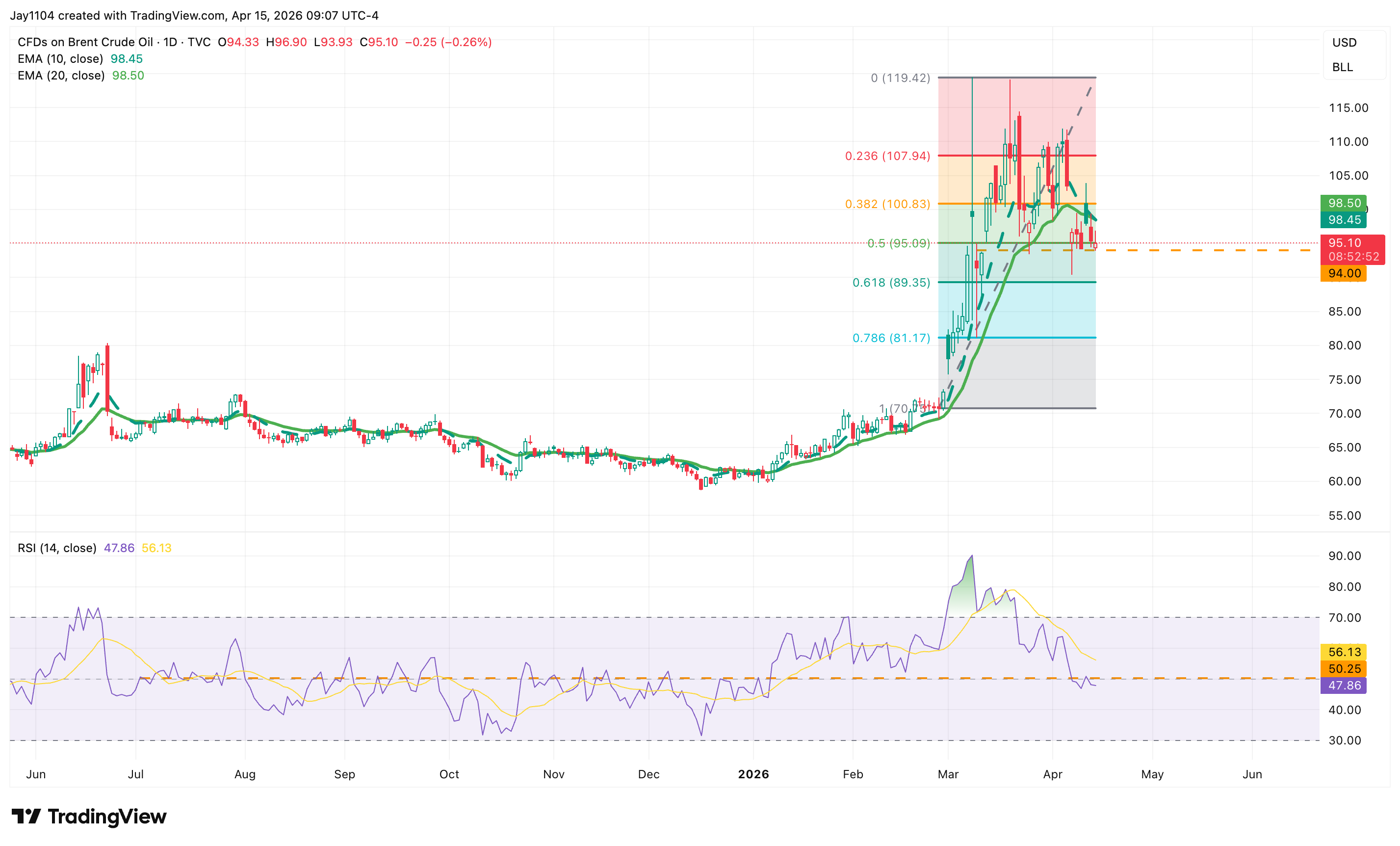
Going into the back half of April, here is what the thesis would have produced for Brent — built off the analysis published on 15 April. This is presented as an illustrative walkthrough of methodology, not a recommendation.