
June Jobs Report Could Trigger a Spike in the VIX and Market Volatility


Liquidity is due to thin out as we enter the second half of 2026, and at Navigating The Market, one of the things we focus on is changes in liquidity. Now is the time to join.
The Independence Day Sale is now live.
30% off Monthly and Annual subscriptions, permanently. Subscribe before July 5 at 11 pm, and the discount locks in forever. Not for a month, not for a year. As long as you stay subscribed.
If you’ve been following along and thinking about going paid, this is the week to do it.
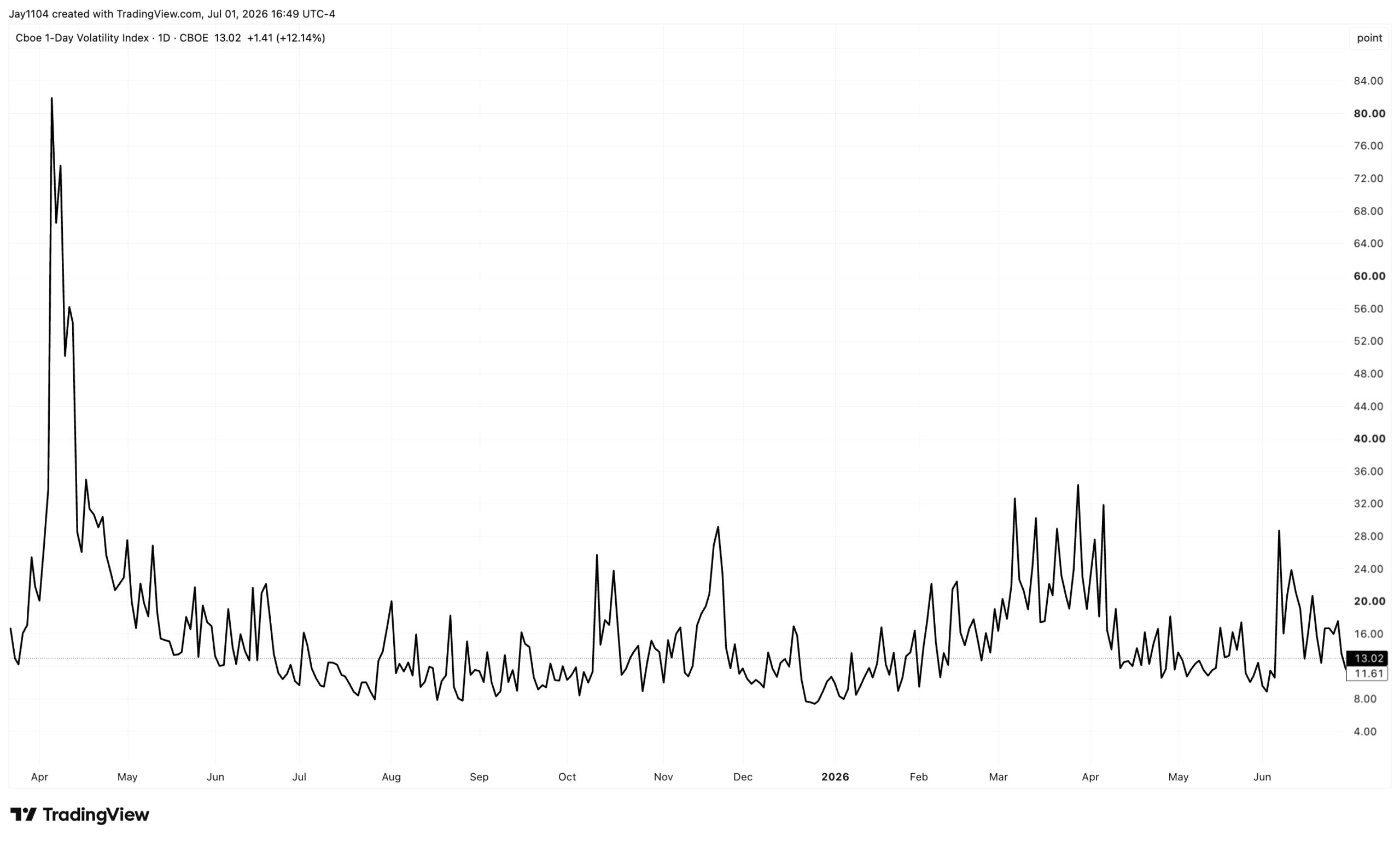
The VIX 1-Day closed at just 13, which is a very low level heading into a jobs report that I think is as important as this one, given the trends we’ve been seeing in the dollar and interest rates. On the surface, the equity market doesn’t seem concerned about this report in the least. It also means that, unless implied volatility really ramps up overnight, the odds of a post-jobs-report volatility crush are unlikely.
Meanwhile, Kalshi is betting on 140,000 jobs being created in the June report, and that estimate has been steadily trending higher over the past few days. In some ways, it feels similar to what we saw heading into the May jobs report just a month ago, when expectations were also relatively low.
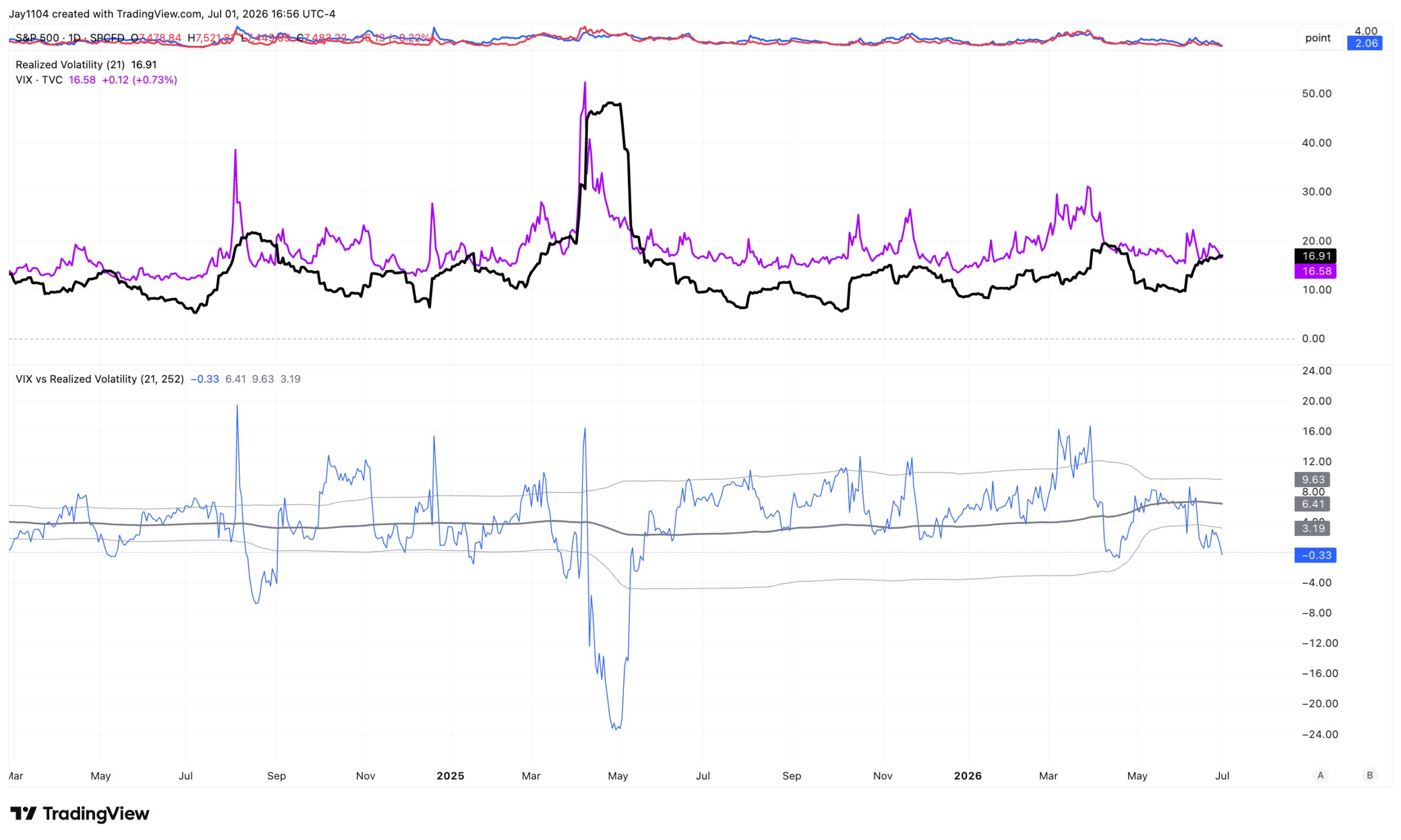
It is worth noting that 21-day realized volatility is now trading above the VIX Index. That doesn’t mean much by itself, especially if realized volatility in the S&P 500 continues to move lower. However, a sudden jolt could push the VIX significantly higher. Based on that historical spread, we could easily see the VIX move back to 22.
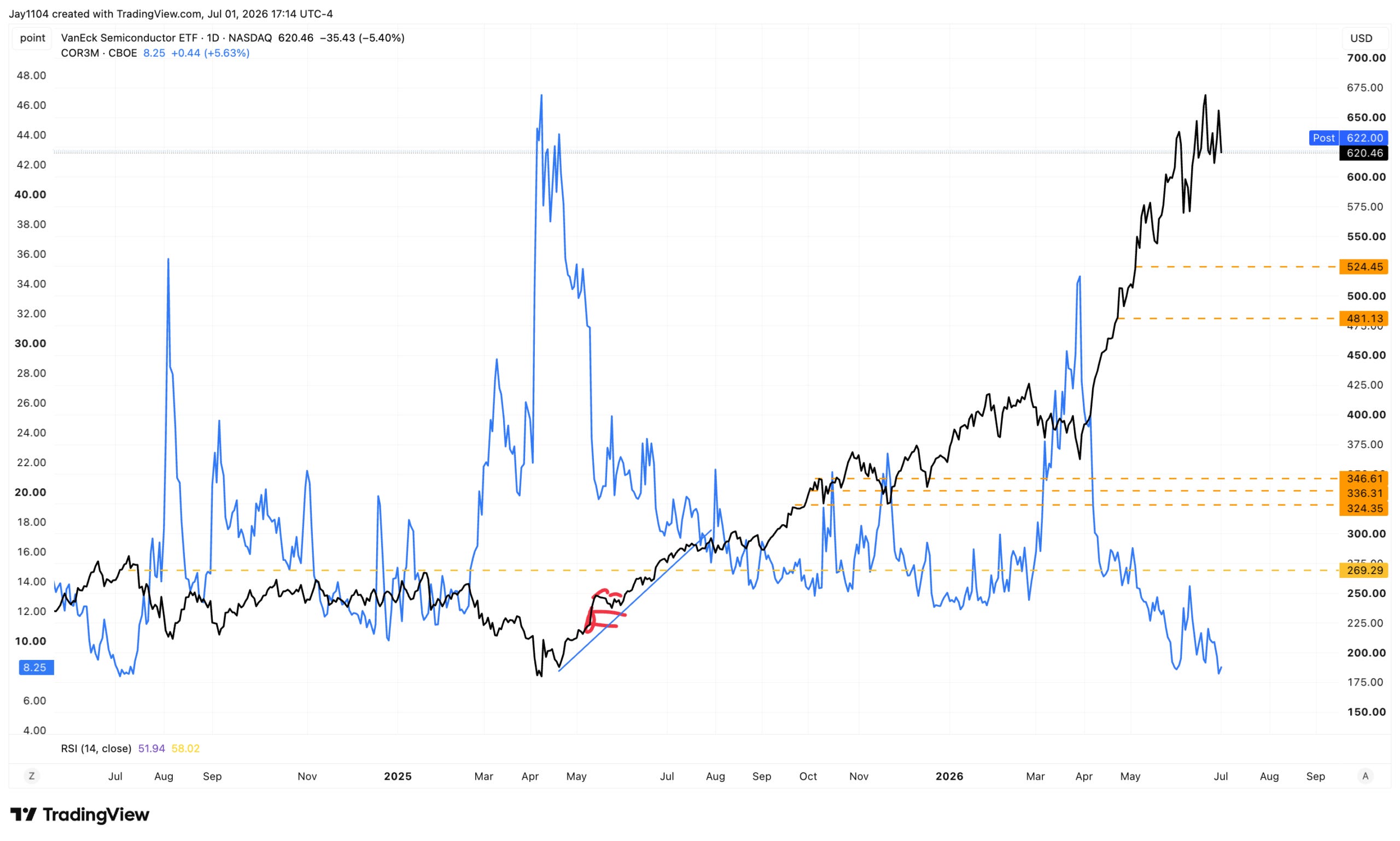
Meanwhile, the 3-month implied correlation index rose slightly today and failed to surpass the July 3, 2024, low. This was due to a sharp decline in semiconductor stocks. The SMH dropped by more than 5%, and it has clearly been the leader of both the market and the dispersion trade for some time.
It is hard to say what will happen next because semiconductors are inherently volatile. However, with implied correlation this low and index implied volatility very low relative to single-stock implied volatility, you could certainly see a situation where a hot jobs report triggers a surge in the VIX Index and a fairly sharp unwind of the market’s dispersion trade.
Additionally, a hot jobs report would likely trigger further dollar strength and push interest rates higher. While that would almost certainly weaken the JPY and the KRW, if this is truly about a broader regime shift, those weaker currencies carry trades are unlikely to be major factors.
Finally, tomorrow will mark the first day of the Treasury bill net issuance calendar for July, and it will be a heavy one at that.
-Mike
Glossary by ChatGPT
21-Day Realized Volatility — A measure of the S&P 500’s actual price fluctuations over the previous 21 trading days.
Carry Trade — An investment strategy that borrows in a low-interest-rate currency to invest in higher-yielding assets or currencies.
Dispersion Trade — An options strategy that profits from differences between index volatility and the volatility of its individual components.
Implied Correlation Index — A market-derived measure estimating how closely stocks within an index are expected to move together.
Implied Volatility — The market’s expectation of future price volatility derived from option prices.
Jobs Report — The monthly U.S. employment report that includes nonfarm payrolls, unemployment, and wage data, often driving significant market moves.
Kalshi — A regulated prediction market where participants trade on the probability of future economic, political, and financial events.
KRW — The South Korean won, the official currency of South Korea.
Net Treasury Bill Issuance — The amount of new Treasury bills issued after accounting for maturing bills, affecting short-term liquidity conditions.
SMH — The VanEck Semiconductor ETF, a widely followed exchange-traded fund tracking semiconductor companies.
Treasury Bills (T-Bills) — Short-term U.S. government securities with maturities of one year or less.
VIX 1-Day — A measure of the market’s expected volatility over the next trading day based on S&P 500 options.
VIX Index — The CBOE Volatility Index, which measures the market’s expectation of 30-day volatility for the S&P 500.
Volatility Crush — A sharp decline in implied volatility, typically occurring after a major scheduled event such as an economic report or earnings release.
Disclosure
This report contains independent commentary to be used for informational and educational purposes only. Michael Kramer is a member and investment adviser representative with Mott Capital Management. Mr. Kramer is not affiliated with this company and does not serve on the board of any related company that issued this stock. All opinions and analyses presented by Michael Kramer in this analysis or market report are solely Michael Kramer’s views. Readers should not treat any opinion, viewpoint, or prediction expressed by Michael Kramer as a specific solicitation or recommendation to buy or sell a particular security or follow a particular strategy. Michael Kramer’s analyses are based upon information and independent research that he considers reliable, but neither Michael Kramer nor Mott Capital Management guarantees its completeness or accuracy, and it should not be relied upon as such. Michael Kramer is not under any obligation to update or correct any information presented in his analyses. Mr. Kramer’s statements, guidance, and opinions are subject to change without notice. Past performance is not indicative of future results. Neither Michael Kramer nor Mott Capital Management guarantees any specific outcome or profit. You should be aware of the real risk of loss in following any strategy or investment commentary presented in this analysis. Strategies or investments discussed may fluctuate in price or value. Investments or strategies mentioned in this analysis may not be suitable for you. This material does not consider your particular investment objectives, financial situation, or needs and is not intended as a recommendation appropriate for you. You must make an independent decision regarding investments or strategies in this analysis. Upon request, the advisor will provide a list of all recommendations made during the past twelve months. Before acting on information in this analysis, you should consider whether it is suitable for your circumstances and strongly consider seeking advice from your own financial or investment adviser to determine the suitability of any investment.