
Is The Market Finally Questioning the AI Spending Trade?


The S&P 500 finished the day flat, largely due to the rotation in the market between mega-cap names and the semis. The market is finally waking up to the idea that what is good for the semis may be bad for the mega-cap names. We already knew that for a handful of software players, but today’s news from Apple about price hikes sent a different message: higher hardware prices are starting to squeeze margins enough that price increases are now inevitable. The question is whether this is a one-off or the start of a new trend.
I don’t know the answer, but at some point, one has to think that one of these big AI capex spenders is going to say, “Enough.” Which company will be first is the question. With second-quarter earnings quickly approaching, you have to look at the companies that report on a fiscal calendar, perhaps those that are starting a new fiscal year, because they could be the first to jump in front of this.
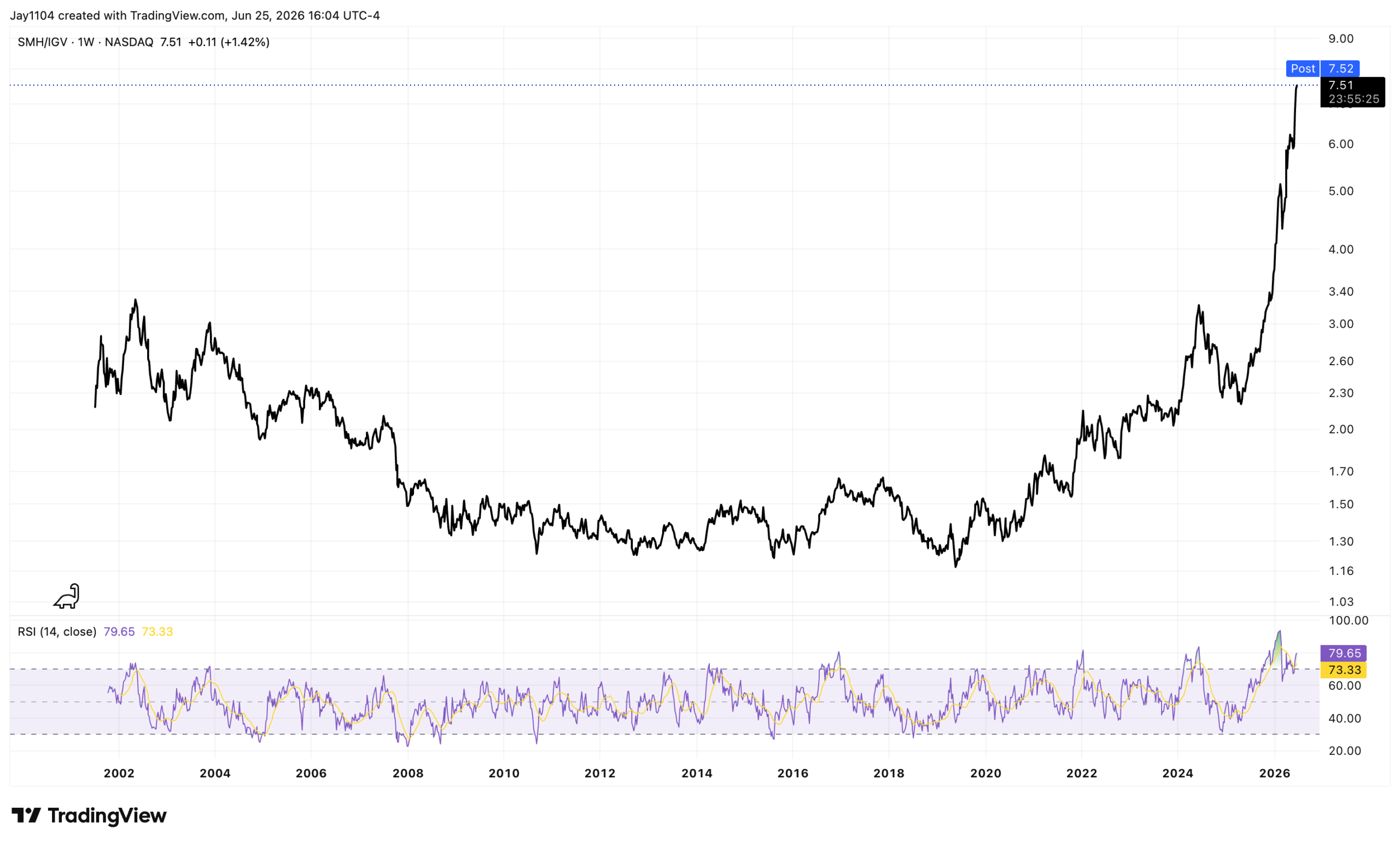
When looking at the software-to-hardware ratio, using the IGV-to-SMH ratio, it is clear who is winning for now.
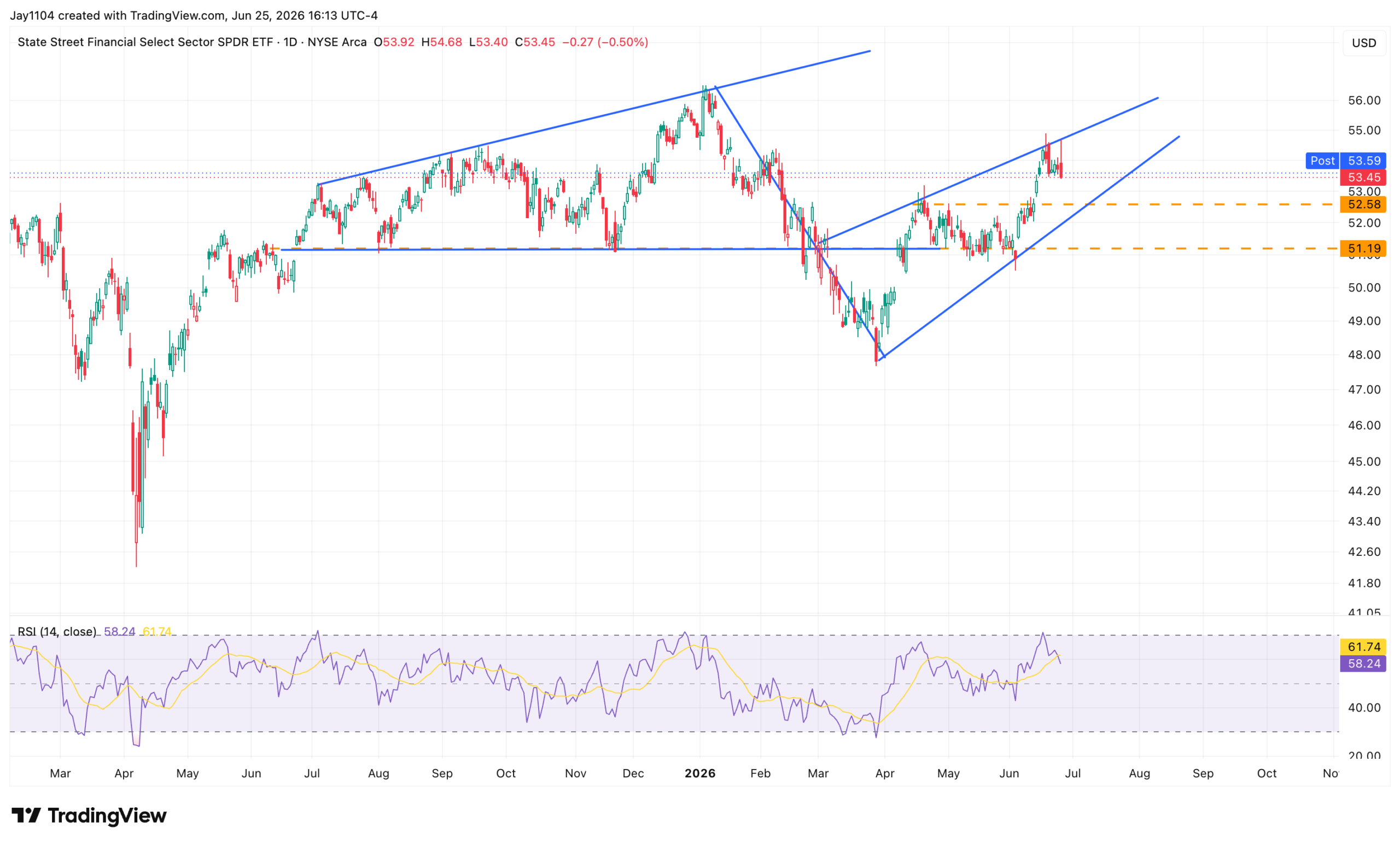
I noticed today that the financial sector (XLF) appears to have formed a rising wedge. When connecting that pattern with the broader trend from January through March, it looks like it may be forming a bear pennant. We won’t know if it is truly a bear pennant until we see the XLF either rise above $55 or fall below $52.50. A break below $52.50 would confirm the bear pennant, while a move above $55 would invalidate the pattern.
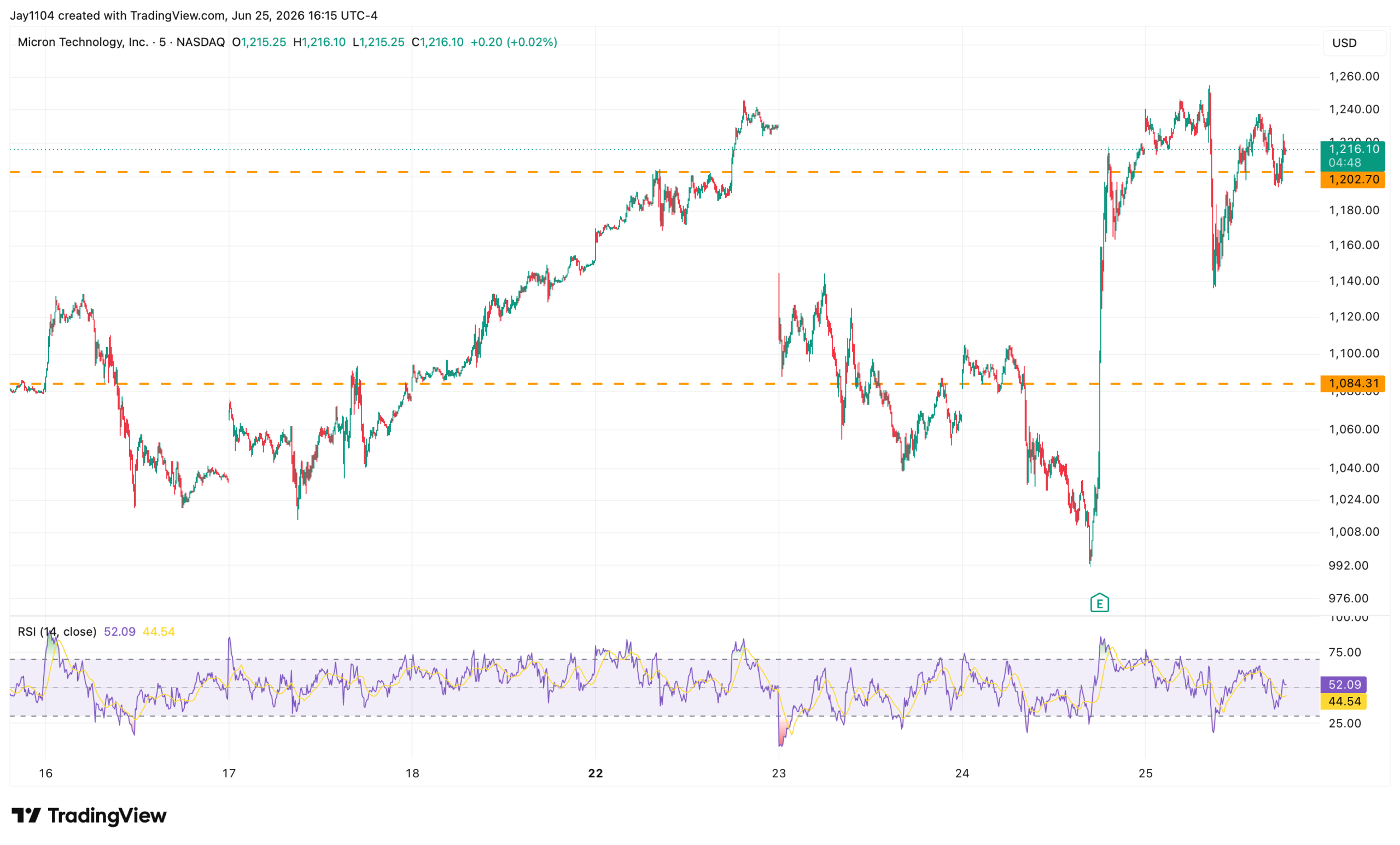
Finally, for now, Micron’s call wall has held, with the stock pinned around that level for most of the day. No surprise there.
-Mike
Glossary by ChatGPT
AI Capex — Capital expenditures made by companies to build or expand artificial intelligence infrastructure, including chips, servers, and data centers.
Bear Pennant — A bearish continuation chart pattern characterized by a brief consolidation following a decline before another potential move lower.
Call Wall — An options strike with significant open call interest that can act as a price magnet or resistance due to dealer hedging activity.
Fiscal Calendar — A company’s reporting schedule based on its fiscal year, which may differ from the standard calendar year.
IGV-to-SMH Ratio — A relative strength measure comparing software stocks (IGV) to semiconductor stocks (SMH) to gauge which group is outperforming.
Mega-Cap — A company with an exceptionally large market capitalization, typically among the largest publicly traded firms.
Rising Wedge — A technical chart pattern marked by converging upward-sloping trendlines that often signals weakening momentum and a potential downside reversal.
Semis — Industry shorthand for semiconductor companies and stocks.
Disclosure
This report contains independent commentary to be used for informational and educational purposes only. Michael Kramer is a member and investment adviser representative with Mott Capital Management. Mr. Kramer is not affiliated with this company and does not serve on the board of any related company that issued this stock. All opinions and analyses presented by Michael Kramer in this analysis or market report are solely Michael Kramer’s views. Readers should not treat any opinion, viewpoint, or prediction expressed by Michael Kramer as a specific solicitation or recommendation to buy or sell a particular security or follow a particular strategy. Michael Kramer’s analyses are based upon information and independent research that he considers reliable, but neither Michael Kramer nor Mott Capital Management guarantees its completeness or accuracy, and it should not be relied upon as such. Michael Kramer is not under any obligation to update or correct any information presented in his analyses. Mr. Kramer’s statements, guidance, and opinions are subject to change without notice. Past performance is not indicative of future results. Neither Michael Kramer nor Mott Capital Management guarantees any specific outcome or profit. You should be aware of the real risk of loss in following any strategy or investment commentary presented in this analysis. Strategies or investments discussed in this analysis may fluctuate in price or value. Investments or strategies mentioned in this analysis may not be suitable for you. This material does not consider your particular investment objectives, financial situation, or needs and is not intended as a recommendation appropriate for you. You must make an independent decision regarding investments or strategies in this analysis. Upon request, the advisor will provide a list of all recommendations made during the past twelve months. Before acting on information in this analysis, you should consider whether it is suitable for your circumstances and strongly consider seeking advice from your own financial or investment adviser to determine the suitability of any investment.