
Even After CPI and PPI Long-Term Treasury Rates Still Look Too Low

Despite an in-line CPI reading and a slightly weaker PPI reading, 10-year rates are flat for the week, while 30-year rates are actually up 2 bps. I don’t think many would have expected that, given all the worries around inflation we read about. To me, the recent rise in rates is about more than just inflation. It is perhaps about the normalization of the yield curve, given that it seems pretty clear at this point that the rate-cutting cycle is over.
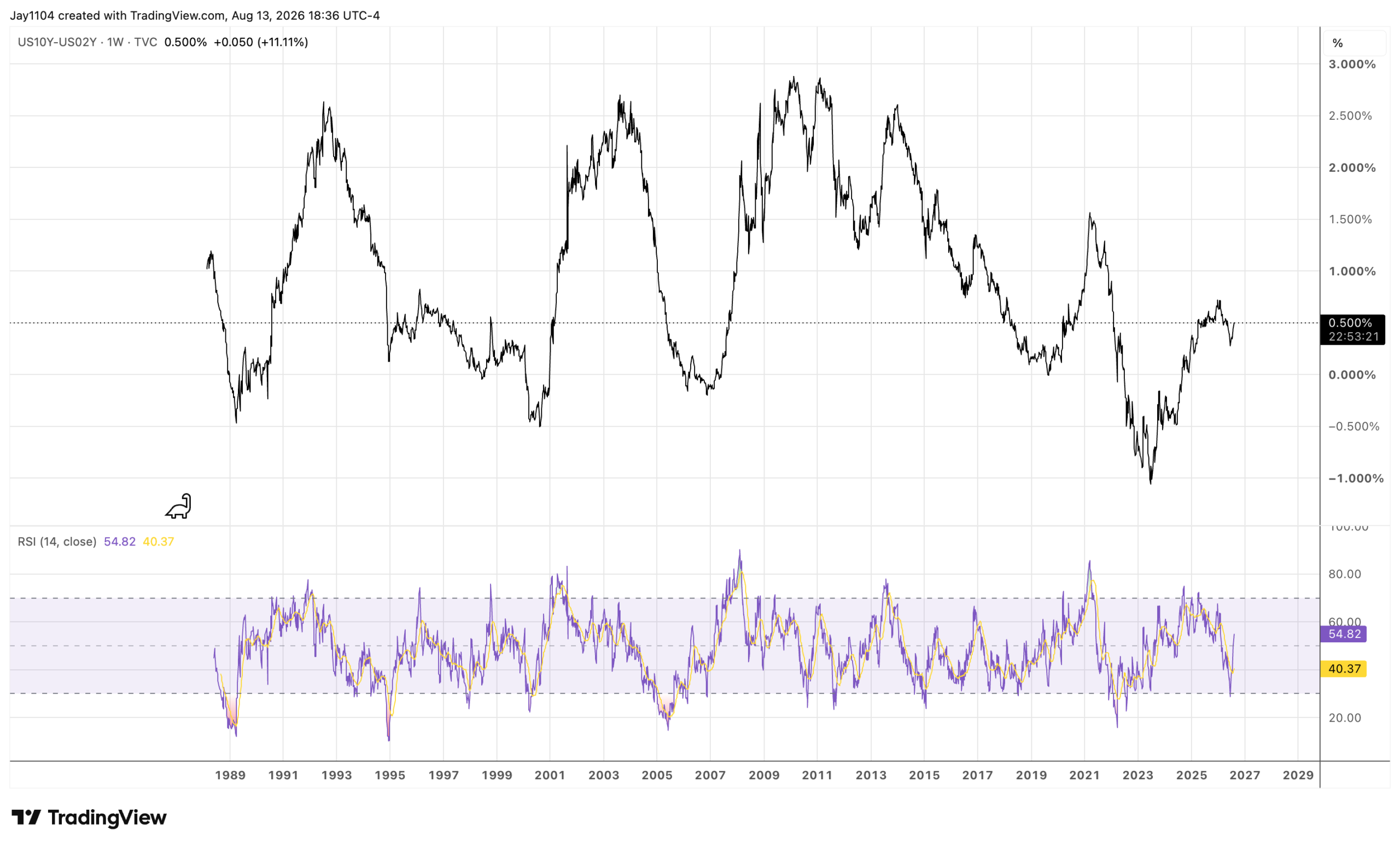
If that is the case, then it would seem that 10- and 30-year rates are too low relative to the 2-year Treasury and should be much higher. A spread of just 50 bps doesn’t seem wide enough at this point, especially when you look at that spread on a historical basis. It tells us one of two things: 2-year rates should be much lower, or 10-year rates should be much higher. One issue is that the yield curve never steepened enough during the 2022 and 2023 rate-hiking cycle because markets were convinced the Fed would break the economy and trigger a recession. That never happened. The spread being this low at this point seems silly.
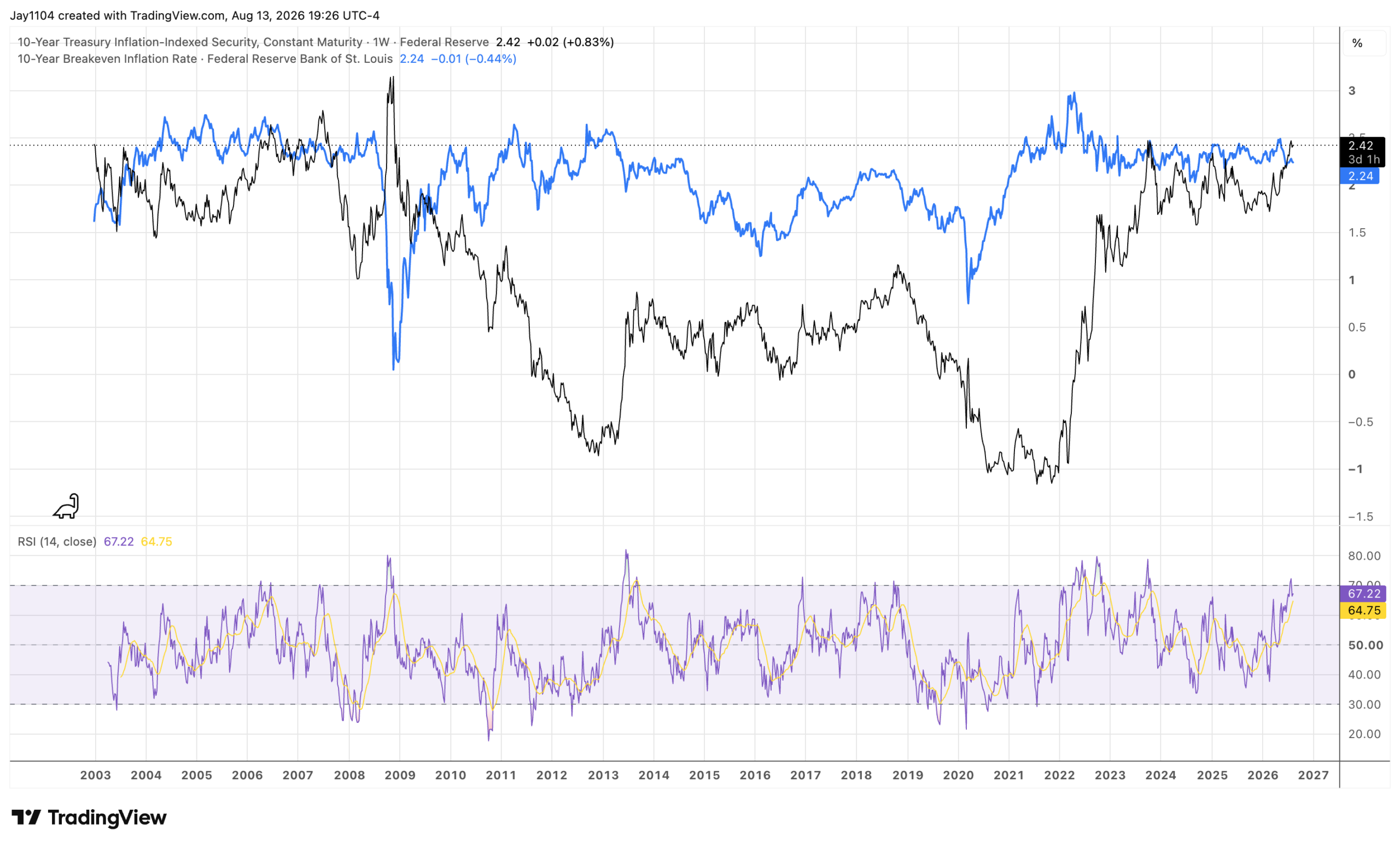
The more interesting development is that the 10-year real yield is now higher than the 10-year breakeven inflation rate. In effect, higher real rates are doing some of the heavy lifting for the Fed by tightening financial conditions and putting downward pressure on inflation. The question is how high real yields ultimately need to rise, and how long they need to remain elevated, to sufficiently suppress inflation in the real economy.
Judging by the strength in gold and most risk assets, it would seem that real rates are still not restrictive enough. If that is the case, and breakeven inflation remains relatively stable, any further increase in real yields would likely have to come through a higher nominal 10-year Treasury rate.
-Mike
Glossary by ChatGPT
Basis Point (bp) — One-hundredth of a percentage point, commonly used to measure changes in interest rates and bond yields.
Breakeven Inflation Rate — The difference between nominal and inflation-protected Treasury yields, representing the market’s implied average inflation expectation over a given period.
Financial Conditions — The combined influence of interest rates, credit spreads, asset prices, and other financial variables on economic activity.
Nominal Treasury Yield — The stated yield on a Treasury security before adjusting for expected inflation.
Rate-Cutting Cycle — A period during which the Federal Reserve progressively lowers its policy interest rate.
Real Yield — A bond yield adjusted for expected inflation, representing the inflation-adjusted return available to investors.
Restrictive — A monetary or financial condition sufficiently tight to slow economic activity and reduce inflationary pressure.
Yield Curve — A graphical representation of Treasury yields across different maturities.
Yield Curve Normalization — The process by which the relationship between short- and long-term interest rates returns toward a more historically typical configuration.
Yield Spread — The difference in yield between two debt securities or Treasury maturities.
Disclosure
This report contains independent commentary to be used for informational and educational purposes only. Michael Kramer is a member and investment adviser representative with Mott Capital Management. Mr. Kramer is not affiliated with this company and does not serve on the board of any related company that issued this stock. All opinions and analyses presented by Michael Kramer in this analysis or market report are solely Michael Kramer’s views. Readers should not treat any opinion, viewpoint, or prediction expressed by Michael Kramer as a specific solicitation or recommendation to buy or sell a particular security or follow a particular strategy. Michael Kramer’s analyses are based upon information and independent research that he considers reliable, but neither Michael Kramer nor Mott Capital Management guarantees its completeness or accuracy, and it should not be relied upon as such. Michael Kramer is not under any obligation to update or correct any information presented in his analyses. Mr. Kramer’s statements, guidance, and opinions are subject to change without notice. Past performance is not indicative of future results. Neither Michael Kramer nor Mott Capital Management guarantees any specific outcome or profit. You should be aware of the real risk of loss in following any strategy or investment commentary presented in this analysis. Strategies or investments discussed may fluctuate in price or value. Investments or strategies mentioned in this analysis may not be suitable for you. This material does not consider your particular investment objectives, financial situation, or needs and is not intended as a recommendation appropriate for you. You must make an independent decision regarding investments or strategies in this analysis. Upon request, the advisor will provide a list of all recommendations made during the past twelve months. Before acting on information in this analysis, you should consider whether it is suitable for your circumstances and strongly consider seeking advice from your own financial or investment adviser to determine the suitability of any investment.