
A New Fed Chair Could Rewrite the Playbook for Markets

Tomorrow is the big day, with the Fed meeting and Kevin Warsh’s first major press conference as chair. One thing that seems likely is that Warsh will be very different from the Bernanke-Yellen-Powell lineage. Recall that Warsh resigned from the Fed before the completion of his term and was openly critical of the Fed’s use of quantitative easing. While views can evolve over time, given the mixed legacy of QE and some of his comments during the Senate Banking Committee hearings, it would not be surprising if Warsh remains skeptical of large-scale asset purchases. More broadly, he does not appear to support maintaining an oversized balance sheet.
The FOMC press conference should help clarify several important issues tomorrow. One would think risk assets would not respond well to a more hawkish Fed, particularly one less willing to rely on QE or balance-sheet expansion. The first policy initiative that could potentially be eliminated, perhaps as soon as tomorrow, is the Reserve Management Purchases program that Powell introduced in December. At this point, the Fed is purchasing only about $10 billion per month in Treasury bills, and it would seem reasonable to end the program if Warsh is serious about moving away from the era of ever-expanding balance sheets.
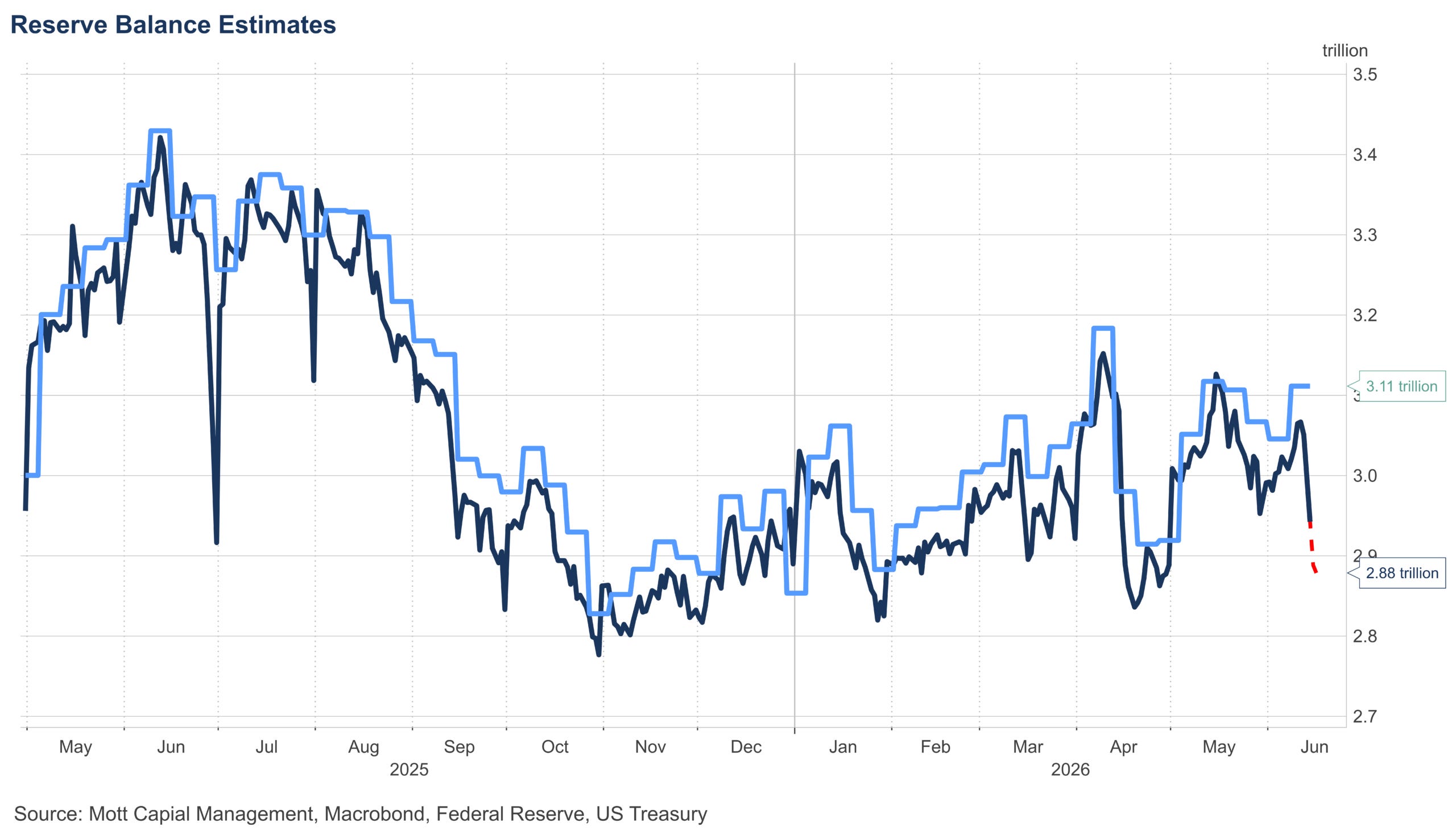
Speaking of the balance sheet, yesterday’s tax day pushed the Treasury General Account to roughly $980 billion, which should have reduced reserve balances to around $2.9 trillion. That is certainly not a disaster, but it does place reserves closer to the lower end of the range where overnight funding rates have previously come under pressure.
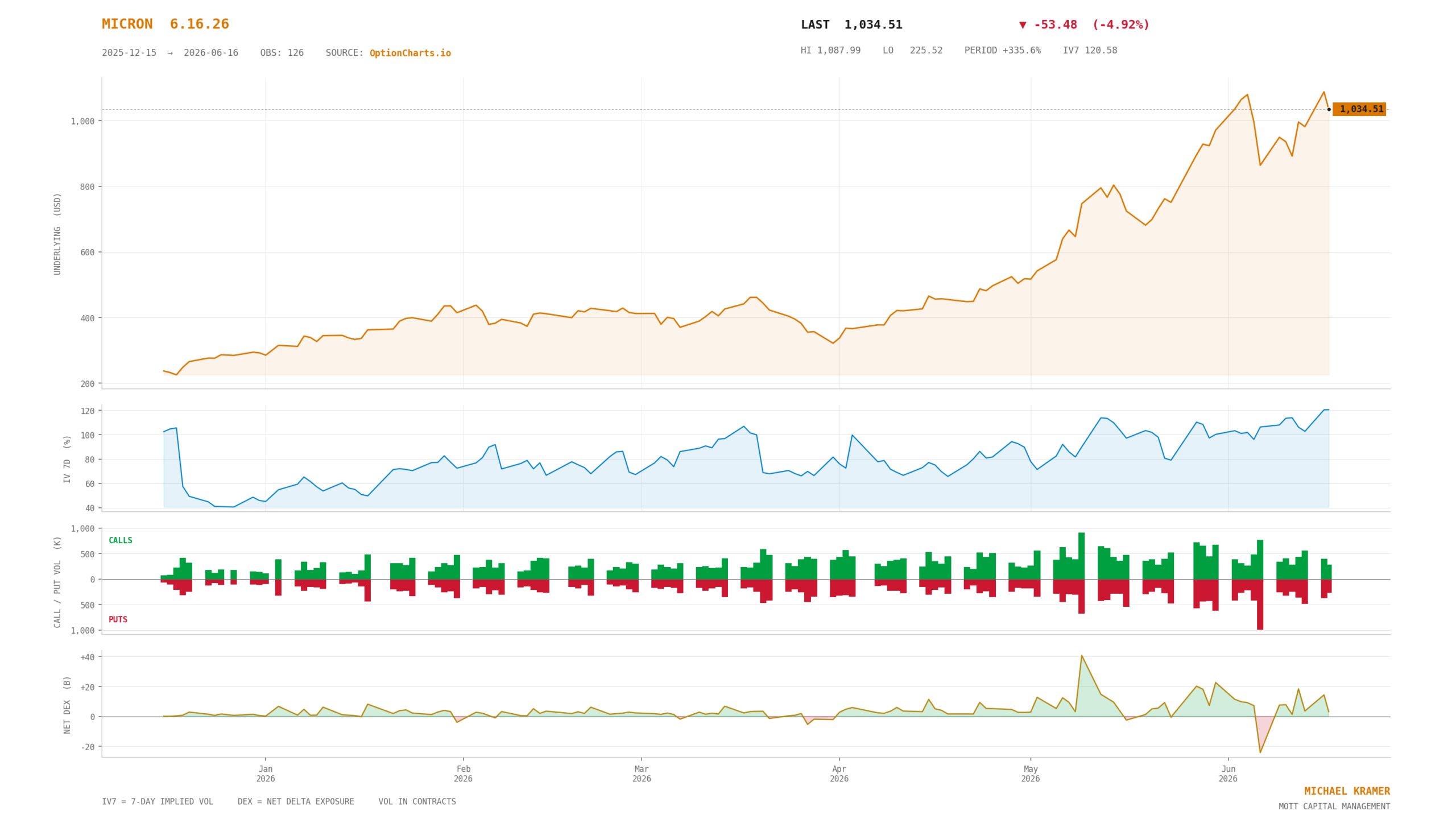
Meanwhile, semiconductors were hit hard, with Micron (MU) falling more than 6%. Options activity was relatively subdued compared with recent days. If options volume continues to fade, the stock could struggle to maintain its recently elevated levels.
One reason may be that SpaceX has become the market’s new shiny object now that options have been listed. If investors begin shifting their focus toward SpaceX, semiconductor stocks could face additional headwinds.
-Mike
Glossary by ChatGPT
Balance Sheet — The collection of assets and liabilities held by the Federal Reserve, including Treasury and mortgage-backed securities.
Federal Open Market Committee (FOMC) — The Federal Reserve committee responsible for setting monetary policy and interest rates.
Hawkish — A monetary policy stance that favors tighter financial conditions to control inflation.
Options Activity — Trading volume and positioning in options contracts that can influence stock price dynamics.
Quantitative Easing (QE) — A monetary policy tool in which the Federal Reserve purchases securities to inject liquidity into the financial system.
Reserve Balances — Deposits held by commercial banks at the Federal Reserve that support banking system liquidity.
Reserve Management Purchases (RMP) — Treasury bill purchases conducted by the Federal Reserve to maintain adequate reserve levels in the banking system.
Risk Assets — Investments such as stocks and corporate bonds that generally carry higher return potential and greater volatility.
Treasury Bills (T-Bills) — Short-term U.S. government securities with maturities of one year or less.
Treasury General Account (TGA) — The U.S. Treasury Department’s primary operating account held at the Federal Reserve.
Disclosure
This report contains independent commentary to be used for informational and educational purposes only. Michael Kramer is a member and investment adviser representative with Mott Capital Management. Mr. Kramer is not affiliated with this company and does not serve on the board of any related company that issued this stock. All opinions and analyses presented by Michael Kramer in this analysis or market report are solely Michael Kramer’s views. Readers should not treat any opinion, viewpoint, or prediction expressed by Michael Kramer as a specific solicitation or recommendation to buy or sell a particular security or follow a particular strategy. Michael Kramer’s analyses are based upon information and independent research that he considers reliable, but neither Michael Kramer nor Mott Capital Management guarantees its completeness or accuracy, and it should not be relied upon as such. Michael Kramer is not under any obligation to update or correct any information presented in his analyses. Mr. Kramer’s statements, guidance, and opinions are subject to change without notice. Past performance is not indicative of future results. Neither Michael Kramer nor Mott Capital Management guarantees any specific outcome or profit. You should be aware of the real risk of loss in following any strategy or investment commentary presented in this analysis. Strategies or investments discussed may fluctuate in price or value. Investments or strategies mentioned in this analysis may not be suitable for you. This material does not consider your particular investment objectives, financial situation, or needs and is not intended as a recommendation appropriate for you. You must make an independent decision regarding investments or strategies in this analysis. Upon request, the advisor will provide a list of all recommendations made during the past twelve months. Before acting on information in this analysis, you should consider whether it is suitable for your circumstances and strongly consider seeking advice from your own financial or investment adviser to determine the suitability of any investment.